Authored by Lance Roberts via RealInvestmentAdvice.com,
AI capex and earnings are now so tightly tied that spending doesn't have to fall to hurt profits. It only has to stop accelerating.
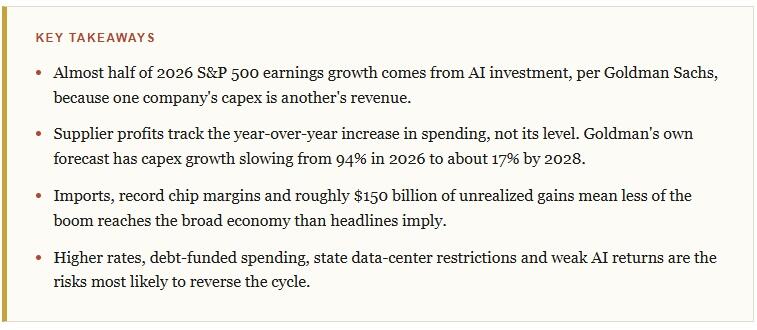
Almost half of the S&P 500's earnings growth this year traces back to one activity: companies buying chips, servers, power gear, and concrete to build artificial intelligence. That's the estimate Goldman Sachs published on September 23. It's also the clearest statement yet of how tightly AI capex and earnings are now linked.1 Most investors read it as a story about the spenders. I think they're looking at the wrong side of the ledger. Capex leaves one company's bank account and appears on another company's income statement, so the "AI earnings boom" depends less on how much is spent than on whether spending continues to grow.
Every Dollar Of Capex Is Someone Else's Revenue
When a hyperscaler commits $10 billion to a data center, that money doesn't vanish into a building. It goes to chip designers and memory makers, to the firms making transformers and cooling systems, and to contractors, electricians, and the local utility. Every one of them books it as "revenue." Then their suppliers book revenue from them.
Jerome Levy worked this out early in the last century, and Michal Kalecki formalized it in the 1930s. For the economy as a whole, profits equal investment, minus household, government, and foreign saving, plus divide