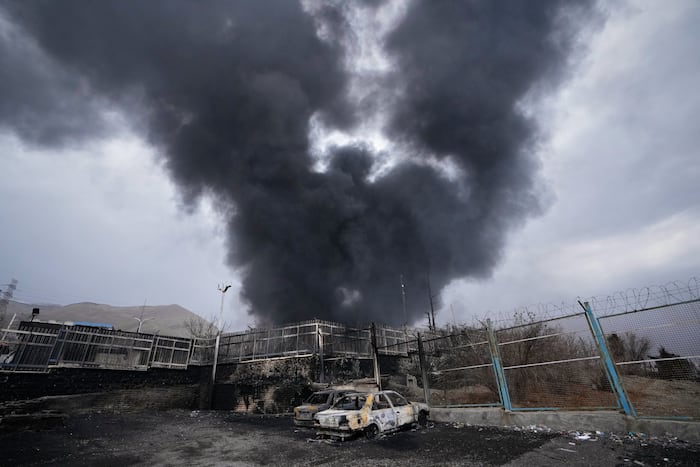
Oil prices continued to soar on Monday as the Iran war intensified, threatening production and shipping across the Middle East and straining energy supplies worldwide.
The price of Brent crude, the international benchmark, briefly surged to $119.50 per barrel on Monday — its highest level since the summer after Russia invaded Ukraine in 2022. West Texas Intermediate, which is produced in the U.S., also soared to $119.48 per barrel at one point.
Those prices fell under the $100 mark later Monday. But that's still much higher than than the roughly $70 a barrel crude was selling for before the U.S. and Israel launched the war against Iran on Feb. 28.
The conflict, now in its second week, is ensnaring countries and infrastructure critical to the production and transportation of oil and gas worldwide. And there's no end in sight. On Monday, Iran named Ayatollah Mojtaba Khamenei to succeed his late father as supreme leader — a new sign of defiance from the country's leaders as the U.S. and Israel continue heavy bombardment.
Fears of attacks have all but stopped tanker traffic in the Strait of Hormuz, a narrow waterway off Iran’s coast where a fifth of the world’s oil sails through on a typical day. Major oil producers in the region like Iraq, Kuwait and the UAE have cut production due to export constraints because they are running out of storage space. Iran, Israel and the U.S. have all struck oil and gas facilities since the war started, worsening supply concerns.
“In economic terms, this is already the largest oil supply shock ever," said Nicholas Mulder, an assitant professor of history who studies the economic impacts of wars at Cornell University. As Gulf producers reduce output and shut down production, he explained, “we are seeing roughly three to four times as many barrels of oil lost as during the 1973 and 1979 oil crises.”
The war’s toll on civilian targets and the energy sector grew over the weekend, notably as oil depots in Tehran smoldered following Sunday strikes by Israel. Meanwhile, across the Persian Gulf, Bahrain accused Iran of striking a desalination plant vital to drinking water supplies. Bahrain’s national oil company declared force majeure for its shipments after an Iranian attack set its refinery complex ablaze. The legal declaration releases the company of contractual obligations because of extraordinary circumstances.
And the war has disrupted critical supply chains. Roughly 15 million barrels of crude oil — about 20% of the world’s oil — typically are shipped every day through the Strait of Hormuz, according to independent research firm Rystad Energy. The threat of Iranian missile and drone attacks has all but stopped tankers carrying oil and gas from Saudi Arabia, Kuwait, Iraq, Qatar, Bahrain, the United Arab Emirates and Iran from traveling through the strait.
Some energy experts warn of drawn-out ramifications.
Jim Burkhard, vice president and global head of crude oil research at S&P Global Energy, pointed particularly to rising production cuts and storage constraints — noting that the crisis had evolved past a solely transporation issue, and that restoring outputs will be “a massive technical exercise that could last weeks or more.”
Source: WPLG
