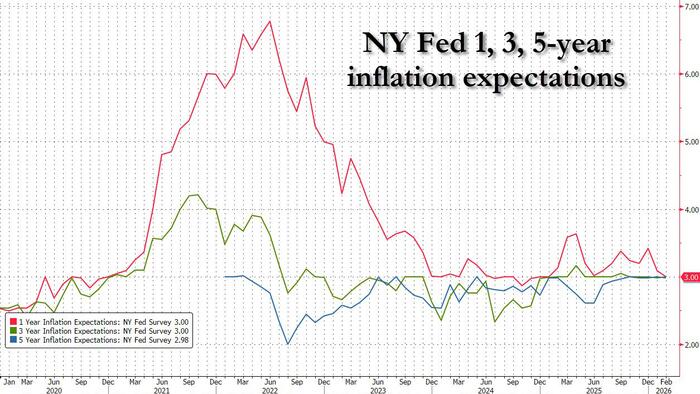
While the latest NY Fed consumer expectations report shows sentiment from February, and does not account for the surge in oil prices as a result of the Iran war, the trend continues to be supportive which would be good news for the US economy if the current energy price spikes proves to be transitory.
In what was the calm before the Persian Gulf storm, Americans’ inflation expectations eased further back in February amid mixed views on the state of the job market and current and future finances. Specifically, the expected level of inflation a year from now dropped to 3% from 3.1% in January, and the lowest since the start of 2025 while the projected level of inflation three and five years from now held steady at 3%.
The New York Fed survey, released Monday, was conducted between February 2-28. As such, it does not capture the public’s reaction to surging oil prices that are the result of the Iran war, which has massively disrupted global energy supplies and sent crude over $100.
Huge increases seen thus far in energy prices are almost certain to drive up already high levels of overall inflation and stand a good chance of pushing the public toward a less benign view on the outlook for price pressures over coming years,assuming the price increase sticks and there is no prompt resolution to the war.
That would present a challenging environment for the Fed, which has been contending with high levels of inflation for years, the result of its post-covid policy error which has pushed inflation above the Fed's 2% target for 60 moinths. Officials agree that where price pressures are expected to go exerts a strong influence on where they stand now, so if the oil shock creates expectations of higher price pressures, that could complicate efforts to get inflation back to target. Then again, the Fed has traditionally ignored one-time shocks which suggests that the Iran shock will only matter if it lasts a longer period of time. Earlier today, wepointed outthat according to the Fed’s FRB/US model,a $20/bbl increase in oil prices only increases unemployment by about 2bps and has almost no impact on core PCE inflation
Turning to specific items, over the next year consumers expect gasoline prices to rise 4.09%; food prices to rise 5.27%; medical costs to rise 9.72%; the price of a college education to rise 9.14%; rent prices to rise 5.88%
The New York Fed survey also found relative calm on the hiring front during February: amid generally lackluster job reports, survey respondents said last monththey project a lower future unemployment rate and a lower prospect of losing a job relative to January.
Specifically, the mean perceived probability oflosing one's job in the next 12 months decreased by 1.0 percentage point to 13.8%,falling slightly below the trailing 12-month average of 14.6%. The mean probability of leaving one's job voluntarily, or the expected quit rate, in the next 12 months decreased by 2.8 percentage points to 15.9%, a new series low.
In more good news for the labor market, the mean unemployment expectations -or the mean probability that the U.S. unemployment rate will be higher one year from now -decreased by 2.0 percentage points to 39.9%.
But respondents also said last month finding new work would be harder than what they thought at the start of the year: the mean perceived probability of finding a job in the next three months if one’s current job was lost decreased by 1.6 percentage points to 44.0%, just slightly above the series low reached in December 2025
Source: ZeroHedge News
