Authored by Lance Roberts via RealInvestmentAdvice.com,
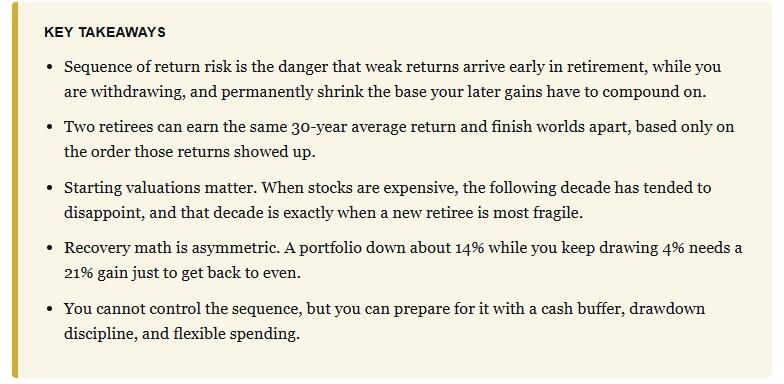
The sequence of return risk is the quiet reason two retirees with identical average returns can end up in very different places.
Let's start with an easy example. Two people retire on the same day with the same million dollars. They have the same portfolio and the same 30-year average return. They should both live comfortably, right? However, while one does die comfortably, the other runs out of money.
Nothing separates them except the ORDER in which their returns arrived. That is the "sequence of return risk," and probably the single most underappreciated threat to anyone who has stopped saving and started spending. While you were accumulating, the order of your returns barely mattered. Once you are withdrawing, it becomes the entire ball game.
What Sequence Of Return Risk Actually Is
The 4% rule originated with financial advisor William Bengen in 1994 and was later stress-tested by three professors in what became known as the Trinity Study. Notably, Bengen wasn't hunting for an average; rather, he wanted the worst starting year in history that a retiree could still have survived. The answer had little to do with typical market returns. W