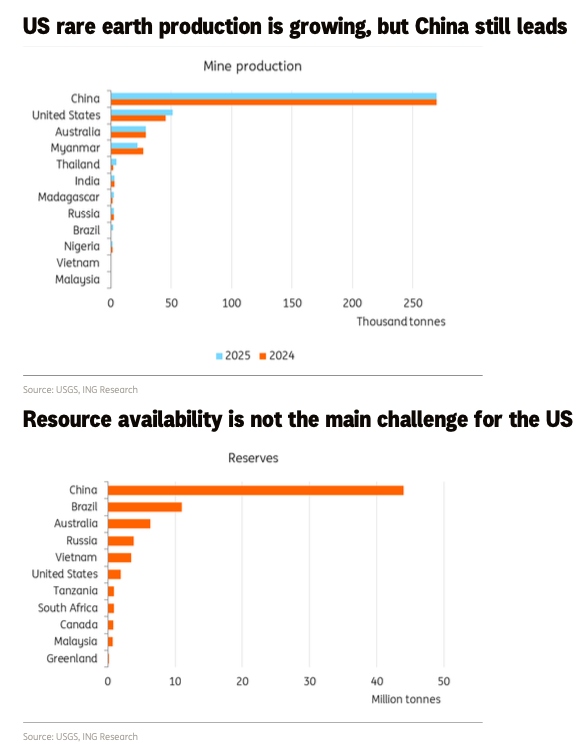
An inconvenient reality for the Trump administration's race to rebuild Western conflict-free critical materials supply chains outside China, whether domestically or through friendshoring, is that it won't break China's chokehold this decade.
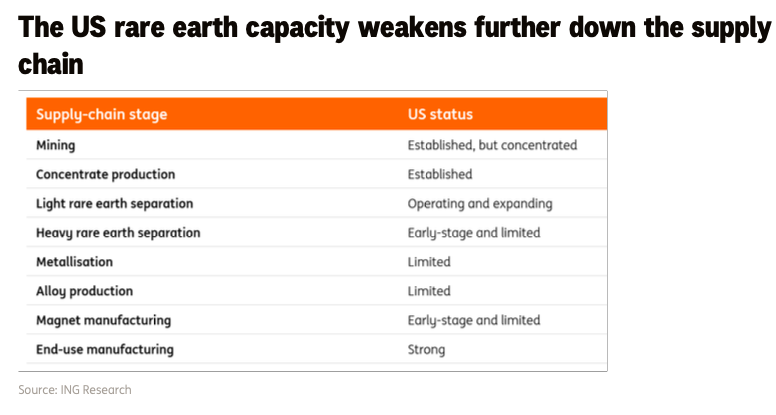
The main problem for the US lies well beyond the mine, ING analysts Ewa Manthey and Coco Zhang wrote in a note on Monday titled "The US rare earth push: what comes next?" Extracting more ore does very little for US companies that depend on Chinese processing plants to turn ore into usable metals, alloys, and finished magnets.
"The US has significant rare earth resources, but its supply chain remains heavily reliant on China. The biggest gaps do not sit in the mine, but rather in processing, heavy rare earth separation and magnet manufacturing," Manthey said.
China accounts for about 60% of mined magnet rare earths, 91% of refined output and 94% of permanent magnet production, Manthey said, citing the International Energy Agency.
Manthey added, "The US rare earth challenge is industrial rather than geological. Its vulnerability lies in the difficult stages between the mine and the finished component."
MP Materials represents both America's progress in rebuilding domestic rare earth supply chains and its continuing constraints. The miner produced a record 50,692 tons of rare-earth oxide in concentrate in 2025 and began manufacturing neodymium-iron-boron magnets in Texas that December.
The biggest gap