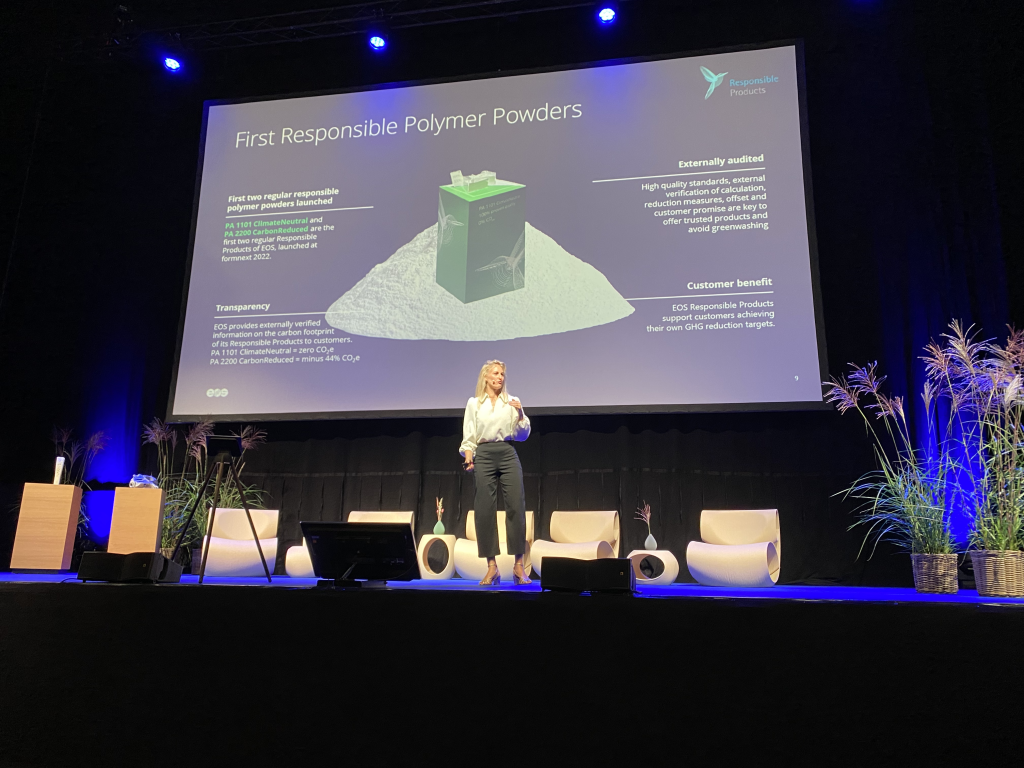
Machines are growing. That much is clear from EOS, the German additive manufacturing company that has spent more than three decades pushing metal powder-bed fusion into industrial use. Those preceding decades were defined by technological possibility; the current phase is defined byinstitutional filtering, the slow sorting process that determines which suppliers can support aerospace, medical, and defence programmes measured in decades rather than quarters.
Chief executive Marie Langer points to theM4 Onyxas evidence of a deliberate push toward larger build volumes and higher throughput, but she is equally focused on what sits above the hardware layer.
“Additive is a digital manufacturing system,” Langer said. “Having a focus on the right software offerings will be really important going forward.”
Hardware scale is increasingly a baseline requirement. Differentiation now sits in process stability, data integrity, and system-level optimisation. Theoperational fault lineis moving upward, from machine specifications to digital control layers.
The company’s software strategy rests on several pillars. Process optimization comes first: ensuring that laser and scanner parameters are tuned to maximize productivity. Alongside that sits a growing portfolio of AI-driven tools aimed at pre-processing, edging closer to right-first-time versus trial-and-error iteration. A third strand covers predictive maintenance, where machine learning models trained on accumulated laser-hours aim to anticipate component failures before they cause unplanned downtime.
The foundation for that last capability is already embedded in current software. The models improve as more machines log more hours. Consignment stock recommendations, flagging which spare parts a facility is most likely to need, are among the near-term applications. Higher uptime reduces the effective cost per part and improves capital efficiency for customers, a necessary condition if additive is to compete not just on geometry but on balance sheet logic.
On the question of who controls the data generated by industrial additive systems (sensor readings, build logs, quality records), EOS describes an open but selective approach. The company offers API access to its platforms and works with ecosystem partners, while retaining discretion over which data flows to which user groups. The volumes involved are substantial: every system shipped from the Munich-area facility now undergoes factory acceptance testing, and that data is fed into a growing statistical database used to derive material allowables and demonstrate process capability to aerospace, medical, and defense customers. Data governance has become one of the quietinstitutional fault lines in advanced manufacturing. Open ecosystems promise flexibility, but industrial customers require traceability, security, and clarity on liability. The tension between openness and control increasingly shapes procurement decisions.
That database is also part of EOS’s response to what remains one of the most stubborn constraints on industrial adoption: material qualification. Participation in programmes such as America Makes has helped buildshared allowables across multiple machine platforms, including competitor systems, and fatigue datasets that would otherwise require years of independent coupon testing.
Two portfolio companies from AM Ventures, the group’s early-stage investment arm, illustrate the application focus. Additive Drives makes electric motor components through additive manufacturing; LightForce, best known for 3D printed orthodontic brackets. Both reflect EOS’s consistent emphasis on application-specific scaling. The venture vehicle traces its origins to the founding philosophy of Hans Langer, who also established Scanlab, the laser scanning component maker that remains part of the group.Arno Held, Chief Venture Officer at AM Ventures, continues to beat the drum for application-oriented additive, most recently describing “the great AM reset” and how AM’s next phase will be driven by “execution, applications, and industrial impact.”
On competitive positioning againstNikon SLMand Trumpf AM (now named ATLIX), Langer pointed to the breadth of EOS’s commercial model: machines, materials, software, and the Additive Minds field engineering organisation, whose staff work with customers on application identification and qualification. “We’re looking into that very holistically,” she said.
Source: 3D Printing Industry
