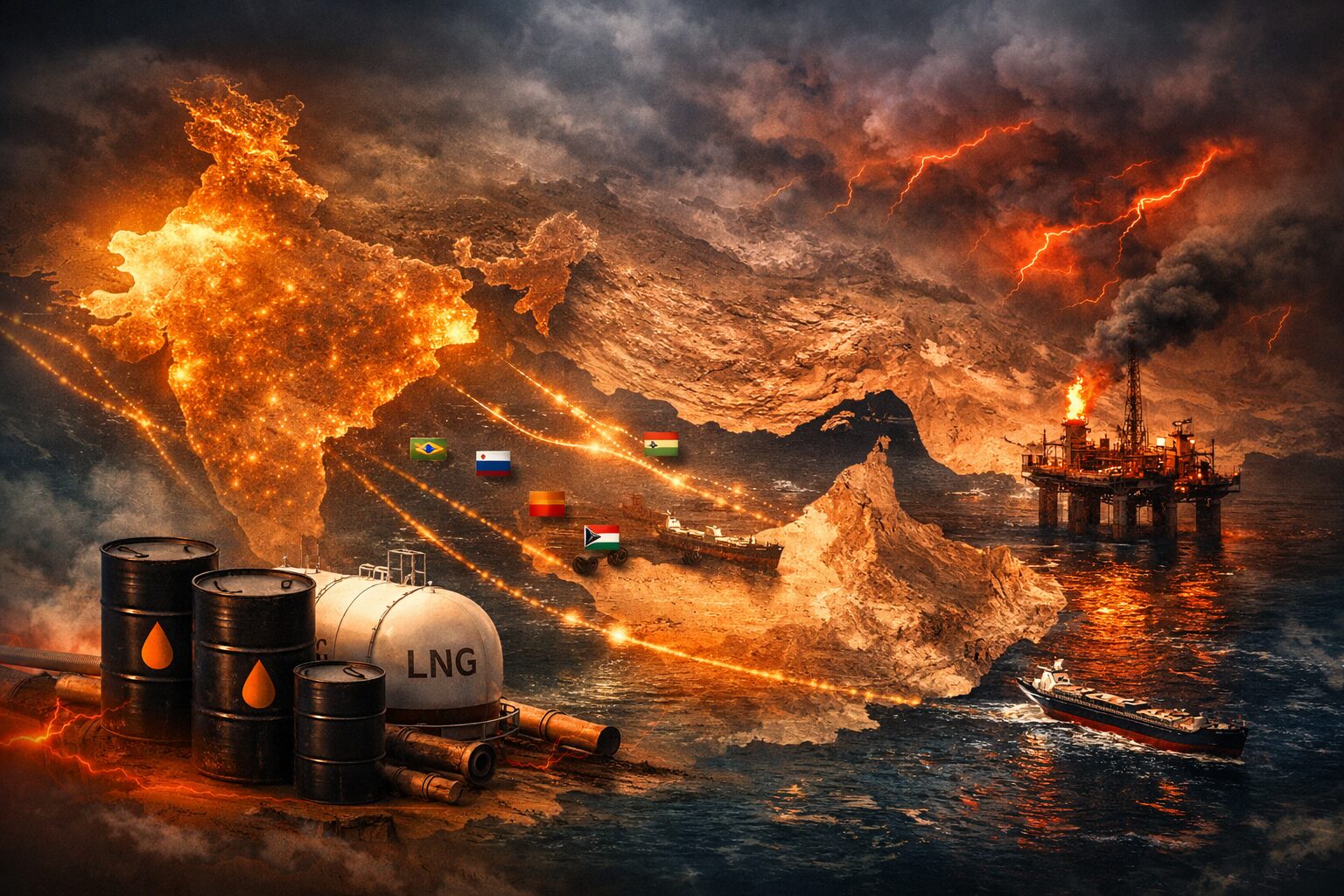
India-Gulf tensions are stress-testing the country’s energy security in ways that analysts have warned about for years. Brent crude has crossed $80 per barrel, the Strait of Hormuz has ground to a near halt, and about 40% to 50% of India’s oil imports move through that route — right now, almost nothing is. The Gulf crisis impact is already spreading well beyond fuel prices, touching remittances, airspace, diplomatic standing, and India’s role as the current BRICS chair.
Also Read:BRICS Faces Major Test as Iran Crisis Threatens Global Oil
At the core of the India-Gulf tensions crisis sits the Strait of Hormuz, a narrow waterway between Iran and Oman that ordinarily handles close to 20% of global oil supply. On March 1, only three tankers carrying around 2.8 million barrels managed to cross — against a daily average of nearly 20 million barrels earlier in 2026. Around 706 tankers are stacked on both sides of the strait at the time of writing.
India holds an estimated 100 million barrels in strategic and commercial reserves. That’s enough to cover roughly 40 to 45 days of Hormuz-dependent supply. That is also not a comfortable buffer for a country that spent $137 billion on crude imports in fiscal year 2024-25. QatarEnergy declared force majeure after a drone strike hit Ras Laffan, cutting off a supplier that accounted for close to 39% of India’s LNG imports in 2024 — all of it offline at the moment.
Go Katayama, principal insight analyst at Kpler, stated:
“More than half of its LNG imports are Gulf-linked, and a significant share is Brent-indexed, so a Hormuz-driven crude spike would simultaneously lift oil import costs and LNG contract prices. That creates a dual physical and financial shock.”
Pankaj Srivastava, senior vice president at energy research firm Rystad Energy, also noted:
“A few dollars’ increase in [oil] prices can materially affect [India’s] energy economics.”
India-Gulf tensions have also forced a sharp reversal on oil sourcing. India’s imports of Russian crude had dropped from 1.85 million barrels per day in November 2025 to around 1.06 million b/d by February 2026 — partly driven by the US-India trade deal that included a commitment to reduce Russian purchases. That deal is now being quietly set aside. According to Bloomberg and ship-tracking data from Kpler and Vortexa, at least three tankers carrying Russian oil have already diverted to Indian ports this week.
Ellen Wald, president of Transversal Consulting, told CNBC:
Source: Watcher Guru