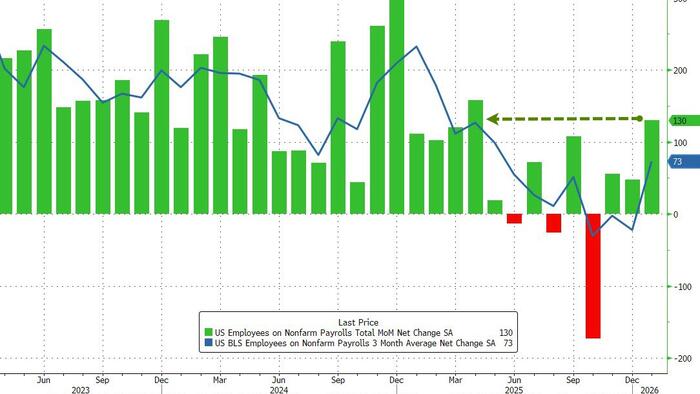
Ahead of today's jobs report, the Trump admin unleashed a full court press to warn markets about what was expected to be a very weak numbers, with Peter Navarro saying"we have to revise our expectations down significantly for what a monthly job number should look like"and Kevin Hassett told CNBC on Monday to"expect slightly smaller job numbers" and that "one shouldn't panic" if the labor data comes in weak.That's also why the whisper number ahead of today's jobs print was well below the consensus, at 35K vs 65K median consensus.
And so with markets and traders fully expecting a ugly print - with Bloomberg's chief economist looking for a 0 January print - the BLS decided to shock everyone, andreported than in January the US added 130K jobs,double the 65K median estimate and up from a downward revised December print of 48K(vs 50K previously).This was also the highest monthly jobs increase since December 2024.
While today's number was double the median consensus, here is some additional color: at 130K, the forecast was higher than 79 out of 80 forecasts, with just Citigroup's 135K forecast higher.
That said, expect today's number to be revised sharply lower last month: that's because the November report was revised down by 15,000, from +56,000 to +41,000, and the change for December was revised down by 2,000, from +50,000 to +48,000. With these revisions, employment in November and December combined is 17,000 lower than previously reported. It gets worse though, with 25 of the past 26 jobs reports revised lower.
There is another reason why today's report will be revised away:while the seasonally adjusted change was a stronger than expected 130K, the unadjusted was a negative 2.649 million.That means thatthe entire delta in today's "surprise beat" was due to seasonal adjustments.
The positive surprise in the payrolls number also translated into improvement in the unemployment rate, which unexpectedly dropped to 4.3%, down from 4.4% in December where it was expected to stay. Among the major worker groups, the unemployment rate for teenagers declined to 13.6 percent in January. The jobless rates for adult men (3.8 percent), adult women (4.0 percent), and people who are White (3.7 percent), Black (7.2 percent), Asian (4.1 percent), or Hispanic (4.7 percent) all posted modest improvements in recent months.
Tied to this, the labor force participation rate rose to 62.5%, up from 62.4% and fractionally better than the expected unchanged print.
There was more positive surprises: in January, hourly earnings rose 0.4% MoM, up from a downward revised (of course) 0.1% in January and above the 0.3% estimate. On a YoY basis, this translated to a 3.7% increase in average hourly earnings, in line with estimates and unchanged from the previous month.
Some more details from the report:
Taking a closer look at the Establishment survey, we find that job gains occurred in health care, social assistance, and construction, while federal government and financial activities lost jobs. Payroll employment changed little in 2025 (+15,000 per month on average).Here is the breakdown:
Source: ZeroHedge News