It’s a bloodbath across Asian markets this morning with Asia being the world’s largest oil-importing region. Based on a Goldman analysis of the impact of higher oil on real GDP growth (chart below), China is the most insulated from supply-driven oil price increases compared to other emerging Asian economies, with $15/bbl higher crude oil prices leading to 0-0.1pp lower GDP growth and 0.1-0.2pp higher headline CPI inflation. This resilience is partly due to the country's economic structure and the potential for government intervention to dampen the pass-through of global price increases to consumers. Increased oil stockpiling last year - some estimates put China's strategic oil resere at 1.5 billion barrels - and very low inflation over the past few years also make China less vulnerable to rising energy prices.
Conversely, Singapore, followed by Taiwan and Korea, will bear the brunt of it with a -1.6% hit to GDP growth and this is only assuming $85 oil. Brent has now crossed the $100 handle with risks to the upside.
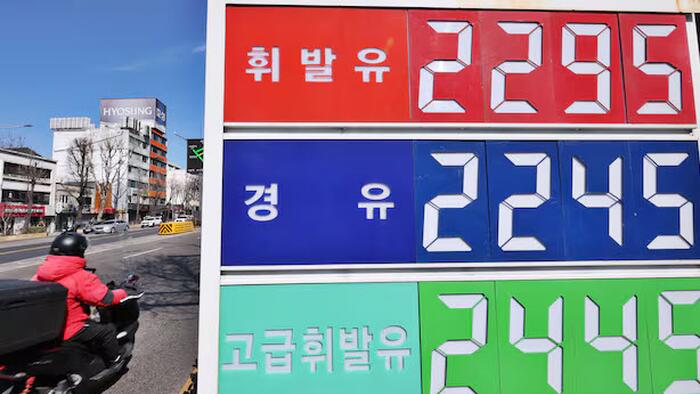
Seen in this light, it is probably not a big surprise thatSouth Korean President Lee Jae Myung said on Monday that authorities would cap domestic fuel prices for the first time in nearly 30 years to contain a spike in prices after the conflict in the Middle East sent global crude prices sharply higher.
Speaking at an emergency cabinet meeting, Lee said in the government would "swifly implement and boldly impement" a maximum price system on petroleum products.
The current crisis "is a significant burden on our economy, which is highly dependent on global trade and energy imports from the Middle East," Lee said in opening remarks.
He added that South Korea will also look for sources of energy beyond supplies shipped via the Strait of Hormuz.
Having emerged as the most cartoonish "market" in the world - whether it is stocks, crypto, or oil, and where even the smallest downtick has to be stabilized by the government or else watch the momentum-chasing lemmings run over the cliff -Lee said a 100 trillion won market stabilization programme should be expanded if needed, and called on the government and the central bank to prepare additional measures to respond to the volatility of the financial and foreign exchange markets.
South Korean shares slumped 8% on Monday to activate circuit breakers for a second time this month on the escalating Middle East conflict, while the won dropped more than 1% to trade near a key psychological barrier of 1,500 per dollar. The Kospi plunged 12% last Wednesday before surging by 12% on Thursday.
Sure enough, shortly after Korea's announcement, the Commercial Times reported that Taiwan would set a weekly cap on oil-price increases as it seeks to cushion the economy from the impact of the Middle East war.
The Taipei-based newspaper reported the limit on Monday, citing Premier Cho Jung-tai and unidentified officials. Cho had previously told reporters on Sunday that the government had activated a price-stabilization mechanism to absorb oil price increases. That came after the Ministry of Economic Affairs said the day before that domestic fuel prices would only rise about 5% this week.
Source: ZeroHedge News