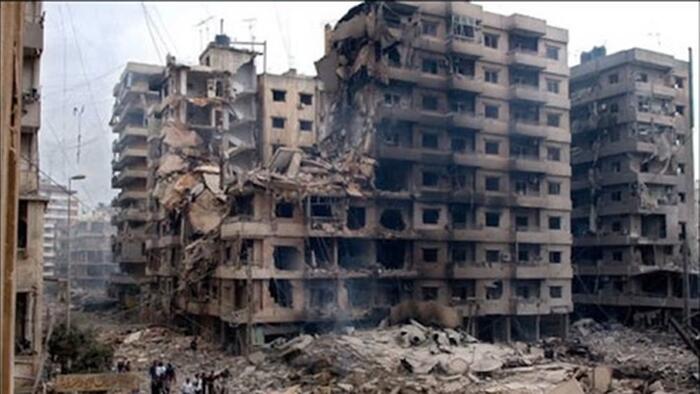
In his recent comments justifying a preventive war against Iran, President Donald Trump declared, "In 1983, Iran’s proxies carried out the Marine barracks bombing in Beirut that killed 241 American military personnel." Secretary of War Pete Hegseth has invoked that attack numerous times.The 1983 Beirut barracks attack is one of the most cited and least understood pretexts for the new war with Iran.
That bombing wasone of President Ronald Reagan's biggest foreign debacles. Lebanon had been wracked by a brutal civil war for seven years when, in June 1982, Israel invaded in order to crush the Palestinian Liberation Organization (PLO).US troops were briefly deployed in August 1982 in Beirut to help secure a ceasefireto facilitate the withdrawal of the PLO forces to Tunisia.
US troops exited Beirut after the PLO withdrawal was largely completed. However,in mid-September 1982, the massacre of more than seven hundred Palestinian refugees threatened to plunge Lebanon into total chaos. Lebanese Christian Phalangist militia butchered residents of the Sabra and Shatila refugee camps. The militia was armed, aided, and fed by the Israeli Defense Force, which surrounded and blockaded the camps.
The Lebanese government appealed to President Reagan to send American troops back to Beirut as a stabilizing factor, and Reagan quickly obliged.As fighting escalated between Christians, Muslims, Syrians, and Israelis in Lebanon, the original US peacekeeping mission became a farce. The US forces were training and equipping the Lebanese army, which was increasingly perceived as a pro-Christian, anti-Muslim force. (Most Lebanese were Muslim, though possibly a thin majority at that point.)
On April 18, 1983 a delivery van pulled up to the front door of the US embassy in Beirut and detonated, collapsing the building and killing forty-six people (including sixteen Americans) and wounding over a hundred others. The US embassy wasa sitting duckfor the terrorist assault: unlike many other U.S. embassies in hostile environments, it had no sturdy outer wall. Newsweek noted, "Delivery vehicles are supposed to go to the rear of the building. Why Lebanese police guarding the embassy driveway would have made an exception in the case of the black van remained a mystery." The attack lacked novelty value, since the Iraqi and French embassies had been wrecked by similar car bomb attacks in the preceding eighteen months.
Five days later, on April 23, 1983, Reagan announced to the press:
"The tragic and brutal attack on our embassy in Beirut has shocked us all and filled us with grief. Yet, because of this latest crimewe are more resolved than ever to help achieve the urgent and total withdrawal of all American forces from Lebanon, or I should say, all foreign forces.I'm sorry. Mistake."
But the actual mistake was a US policy that would cost hundreds of Americans their lives.
By late summer 1983, the Marines were being targeted by Muslim snipers.Reagan administration officials seemed surprised at rising attacks on American soldiers. The Reagan administration responded to sniper potshots and scattered mortar attacks on US troops with a massive escalation. On September 13, Reagan authorized Marine commanders in Lebanon to call in air strikes and other attacks against the Muslims to help the Christian Lebanese army. Defense Secretary Caspar Weinberger vigorously opposed the new policy, fearing it would make American troops far more vulnerable. Navy ships repeatedly bombarded the Muslims over the next few weeks.
At 6:20 A.M. on Sunday morning, October 23, 1983, a lone, grinning Muslim drove a Mercedes truck through a parking lot, past two Marine guard posts, through an open gate, and into the lobby of the Marine headquarters building in Beirut, where hedetonated the equivalent of six tons of explosives. The explosion left a thirty-foot-deep crater and killed 243 marines. A second truck bomb moments later killed 58 French soldiers.
Source: ZeroHedge News