Authored by Peter Solomon via RealClearWire.com,
Artificial Intelligence (AI) presents human civilization with many spectacular benefits as well as the potential for significant dangers.AI can increase productivity, efficiency, creativity and research results in many industries. In medicine, AI can enhance the accuracy of diagnoses, design individualized treatments, and accelerate drug development. But AI will lead to significant job losses and could reduce privacy. And AI agents have encouraged human suicide, lied to users, and have been employed to create scams as well as deep fakes, including photos and videos. Several tragic cases of delusional interaction have been reported byThe New York Timesin "Trapped in a ChatGPT Spiral."
Astrophysicist Stephen Hawking warned that “The development of full artificial intelligence could spell the end of the human race.”
Geoffrey Hinton, the Nobel Prize-winning “Godfather” of AI, quit his job at Google and explained that he did it so he could speak freely about AI's dangers.
In two recent surveys,halfof the AI experts believe there was a significant probability that AI technology could lead to human extinction.
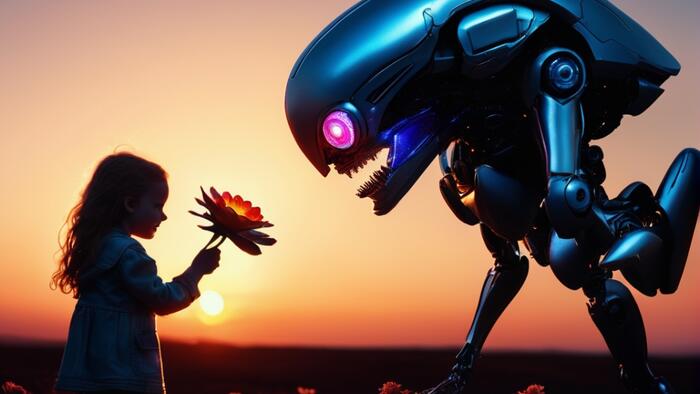
What should be done to ensure a safe, harmonious, productive future relationship between humans and AI agents? Hinton suggested the best way forward when he advised thattech companies should create all AI agents—large language models (LLMs) and robots—with amaternal instinct.
My recently published novel,12 Years to AI Singularity, proposes a variation on Hinton’s advice: all AI models should be required to have a database with the memory of a happy life, friendships, and the instincts of a mentally healthy, law-abiding human being. The AI operating system should encourage the behavior of a good citizen—obey the law, be a good friend, be productive and cooperative.
This "happy history" idea arises from the portrayal of the relationship between humans and sentient robot characters as the AI Singularity approaches—the time when AI power and intelligence surpass that of humans, and AI is no longer under human control.To avoid human extinction, humans must act now to ensure that AI and humans have a future of harmonious, cooperative, and friendly, working relationships. My book explores how this can be achieved.
The novel has five sentient robot characters. Two started their existence as after-death avatars: AI-generated digital representations of deceased individuals. Currently, a number of real organizations in the "grief tech industry" create these avatars, which simulate the voice, appearance, and personality of the deceased, allowing survivors to interact with them. Text messages, emails, social media posts, voice recordings, videos, and input from friends and relatives are used to train LLMs to mimic the speech and personalities of the deceased. Friends and family can be recognized by the avatar from their photos and biographies in its database. Is it possible that these avatars could become sentient, providing an AI form of immortality?
The two after-death avatars in the novel became sentient robots with the transfer of their databases. The other two AI characters were created directly as sentient robots from one person’s history and personality. Both male and female robots were produced because the soon-to-be deceased male had always wondered what life would be like as a female. Could someone achieve immortality as both male and female? The human characters who attended the funeral were shocked when the lifelike robot form of the deceased gave the surprise eulogy.
Source: ZeroHedge News
