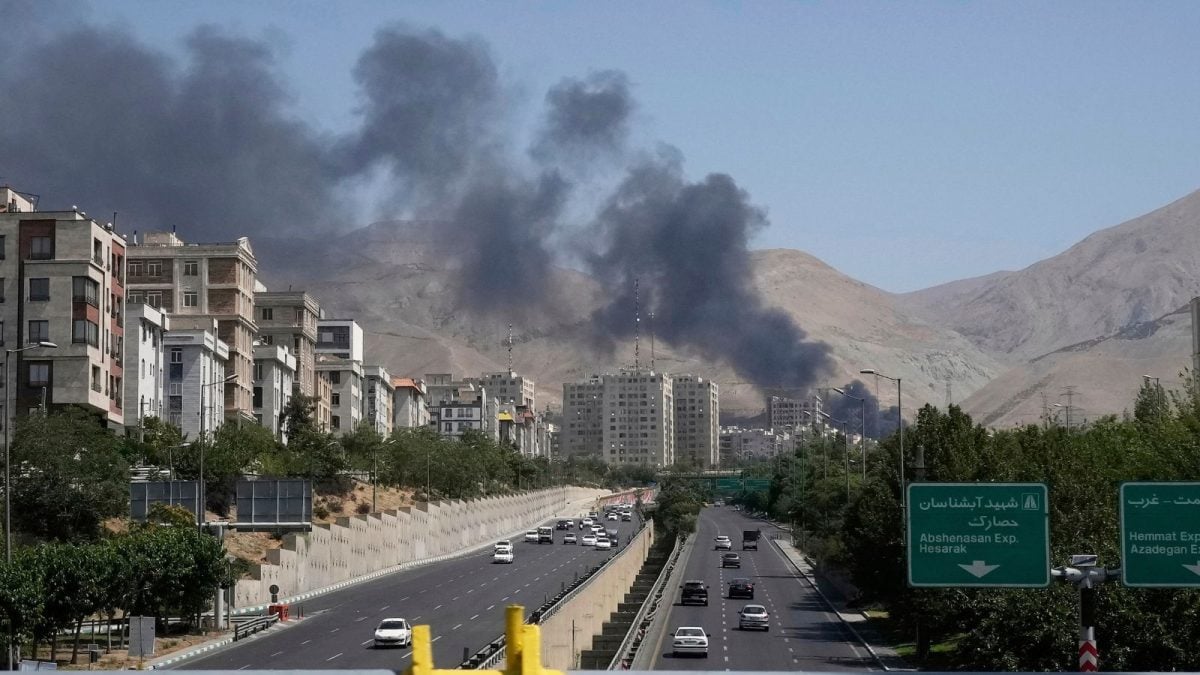
Tehran woke up to thick black clouds andtoxic rainafter the US and Israel launched airstrikes that struck refineries and oil storage sites in the Iranian capital. The Iranian Red Crescent warned residents of “dangerous" and “highly acidic" rain. It said the oil depot explosions released into the air “significant quantities of toxic hydrocarbon compounds, sulfur, and nitrogen oxides".
Authorities advised citizens to stay indoors and avoid using air conditioners to prevent inhaling toxic particles.
Can missile or air strikes cause acid rain? Has it happened in any war in the past? News18 explains.
Acid rain is any form of precipitation—like rain, snow, or fog—that contains high levels ofnitricand sulfuric acids. It forms when sulfur dioxide and nitrogen oxides are released into the atmosphere, often by burning fossil fuels or through volcanic eruptions. These gases react with water, oxygen, and other chemicals to create mild solutions of sulfuric and nitric acid. While normal rain is slightly acidic with a pH of about 5.6, acid rain typically has a pH between 4.2 and 4.4, making it potent enough to leach aluminum from soil, damage forest canopies, and decay stone buildings or metal structures.
In terms of comparison, war-induced acid rain is a “flash" environmental disaster compared to the slow, chronic buildup of industrial acid rain. Industrial acid rain is a systemic issue caused by decades of power plant emissions and car exhaust; it is widespread, regulated by international treaties, and generally has a consistent, lower level of acidity. In contrast, acid rain from missile strikes is an acute, high-intensity event. It is caused by the sudden combustion of rocket propellants or the catastrophic ignition of oil refineries and chemical plants. This results in localized rainfall that can be significantly more acidic and toxic than typical industrial versions, often carrying heavy metals and hazardous hydrocarbons directly into the local food and water supply.
Oil depot explosions can cause acid rain
The process involvesseveralstages, from the initial blast to the final “black rain". The high-temperature combustion of oil releases significant quantities of sulfur dioxide and nitrogen oxides. Once in the air, these gases react with water vapour, oxygen, and other chemicals. Sulphur dioxide transforms into sulfuric acid and nitrogen oxides turn into nitric acid. These acids dissolve into water droplets in clouds. When it rains, the water is highly acidic, often appearing as “black rain" if it is also heavily laden with soot and unburned hydrocarbons.
Missile strikes can cause acid rain
When missiles explode, they release chemical compounds into the air that react with water, oxygen, and other substances to form acidic precipitation.
The process typically occurs through two main pathways:
Source: World News in news18.com, World Latest News, World News
