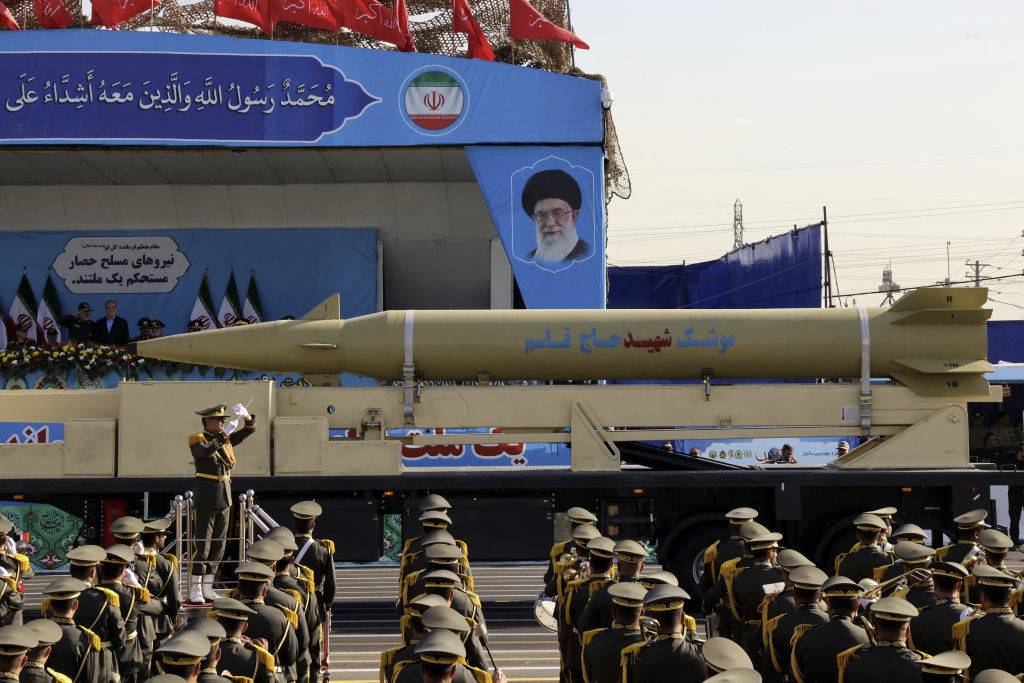
For 47 years, the world has endured a regime that has consistently inflicted terror, suffering, and violence both within its own borders and across the globe. The Islamic Republic of Iran, since its inception in 1979, has built its identity around repression, brutality, and the export of radical ideology. Tens ofthousandsof its own citizens have been killed, tortured, or imprisoned simply for voicing dissent or seeking the simple freedoms we take for granted. The regime has crushed protests, silenced journalists, and employed fear and intimidation to maintain its grip on power. Entire generations of Iranians have lived under a state apparatus that treats humanity as expendable; yet for decades, the international community has not only turned a blind eye; instead, it has actively funded and enabled this half-century horror show. This is a regime that embodies terror at every level, a regime whose brutality is unmatched in modern history, and for far too long, its evil has gone unchecked.
Beyond its borders, Iran has relentlessly exported its ideology of terror. Through the creation, sponsorship, and support of groups such as Hezbollah, Hamas, and Iranian-backed militias in Iraq and Yemen, it has spread death and instability across the Middle East. These groups have carried out massacres, kidnappings, and attacks targeting civilians and military personnel alike. The October massacre against Israel, which claimed the lives of Americans, Israelis, and countless other innocents, is only one example of the deadly reach of this regime's proxies. The Houthis in Yemen, emboldened and armed by Tehran, continue to strike indiscriminately at civilians and infrastructure. Iraqi militias, funded and trained by Iran, have destabilized Iraq and threatened neighboring countries.
In every corner of the region, Iran has sown chaos, violence, and fear.
Globally, it remains a source of terrorism, providing funding, intelligence, and direction to networks that have carried out attacks far beyond the Middle East. Its influence is not just regional; it is global, and its hand is visible in countless acts of evil and destruction.
The regime's hostility toward the United States, Israel and the West has been clear from its founding. From hostage-taking of American citizens during the early years of the revolution to the assassination of U.S. personnel and attacks on American troops in Iraq and elsewhere, Iran has made no secret of its mission to destroy its perceived enemies. American forces have long beentargetedby Iran and its proxies, and the toll has been staggering. In April 1983, a suicide car bombing at the U.S. Embassy in Beirutkilled63 people, a brutal demonstration of the regime's willingness to attack diplomats and civilians alike. Just months later, in October 1983, the Marine barracks in Beirut werestruckin a devastating suicide attack that claimed the lives of 241 U.S. service personnel—thedeadliestsingle attack against American Marines since the World War II battle of Iwo Jima in 1945. These attacks were part of a coordinated campaign of terror orchestrated by Iranian-backed groups, sending a clear message that the United States and its forces were prime targets. American lives weretakenby its proxy networks, and its agents have plotted and carried out attacks across the globe. From the very beginning, the regime declared "Death to America" and "Death to Israel" as central tenets of its ideology. Its constitutionenshrinesthe export of revolution as a state mission, seeking to impose an Islamic governance system across the world. The evidence is clear: this is not a regime capable of reform, compromise, or negotiation. Its mission is radical, its methods brutal, and its intentions unequivocal. It seeks domination, not coexistence.
For decades, the world attempted diplomacy, negotiations, and appeasement. Deals were made, promises were given, and hopes were placed in talks that often delayed confrontation but never changed behavior. The Obama-era nuclear agreement, for example, but emboldened the regime. History teaches us that appeasement does not stop evil; it encourages it, just as Winston Churchill,warned: "Each onehopesthat if he feeds the crocodile enough, the crocodile will eat him last." For decades, nations hesitated, negotiated, and compromised, hoping the regime would act differently, but the result was only more terror, more aggression, and more human suffering.
Now, for the first time in decades, truly courageous leadership has emerged in the presence of U.S. President Donald J. Trump and Israeli Prime Minister Benjamin Netanyahu. They recognized that only decisive action could halt the regime's implacable destruction. Military operations have targeted Iran's military infrastructure, nuclear capabilities, and leadership centers — a necessary strike against a regime whose ideology will not, and cannot, change. This is not aggression for its own sake; it is the enforcement of justice against a state that has long been a global threat. While other countries remain silent, hesitant, or complicit through inaction, the United States and Israel have taken the only path that has a chance of restoring stability, opening the door to freedom and protecting innocent lives.
Iran was actively pursuing nuclear weapons to transform a dangerous regional power into an unstoppable global threat. Iran's regime was driven by ideology and fueled by hate. Iran's core beliefs have not changed in almost half a century, and there is no reason to assume they ever will. This is a regime that does not value life beyond its own survival and expansionist goals.
The consequences of confronting this evil extend far beyond Iran. Terrorist groups across the Middle East would lose a sponsor. The largest source of conflict, instability, and threat to American and Israeli lives would be removed. Peace and stability, long elusive in the region, would finally have a chance to take hold. Standing against tyranny -- not procrastination, appeasement or bribery -- seems to be the only way to protect civilization. The sooner one confronts the tyranny, the less costly it is for both the citizens held hostage by despotic leaders and for those determined to preserve a free way of life.
Europe and other powers have historically sought compromise or neutrality, often under the cowardly hope that peace can be achieved without confrontation. But history has proven the opposite: silence in the face of evil is complicity, and compromise can empower aggressors. The international community needs to recognize that supporting the United States and Israel in their decisive action is not aggression; it is the defense of global stability, civilization and human life. Nations need to stop enabling the regime through hesitation, silence, or negotiation and join the courageous few who have acted decisively.
Source: Gatestone Institute :: Articles
