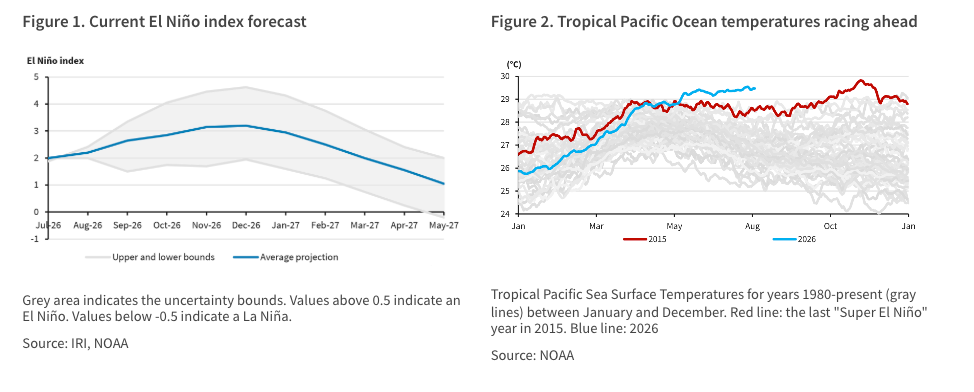
Wall Street coverage of a record-breaking Super El Niño is only growing as agricultural commodities break out. Yet the rally extends well beyond the agricultural complex, with industrial metals and other critical materials showing signs of tightness in physical markets.
Whether it is veteran commodities strategist Jeff Currie turning bullish or UBS urging clients this week to "position for a commodity upcycle," the message is becoming louder: Commodity markets are tightening as adverse weather, years of underinvestment, declining inventories, and China's restrictions on critical-material exports converge into what appears to be an emerging supply shock.
Focusing on the agricultural complex, Craig Rye, a sustainable investing research analyst at Barclays, wrote in a note on Friday that El Niño is strengthening in the tropical Pacific, threatening to disrupt global agriculture, energy production, and industrial commodity markets.
Rye cited new multi-model forecasts from the International Research Institute for Climate and Society showing that the El Niño index could peak near 3.2 degrees Celsius between late 2026 and early 2027. If realized, the event would be about 15% stronger than the 2015-16 Super El Niño.
Rye explained:
Rising confidence in a historic El Niño increases the likelihood of significant disruptions across agricultural, energy and industrial commodity markets. Historical El Niño events have often been associated with
Rye expects the largest near-term risks concentrated in weather-sensitive agricultural commodities.
« Back to The Culture War