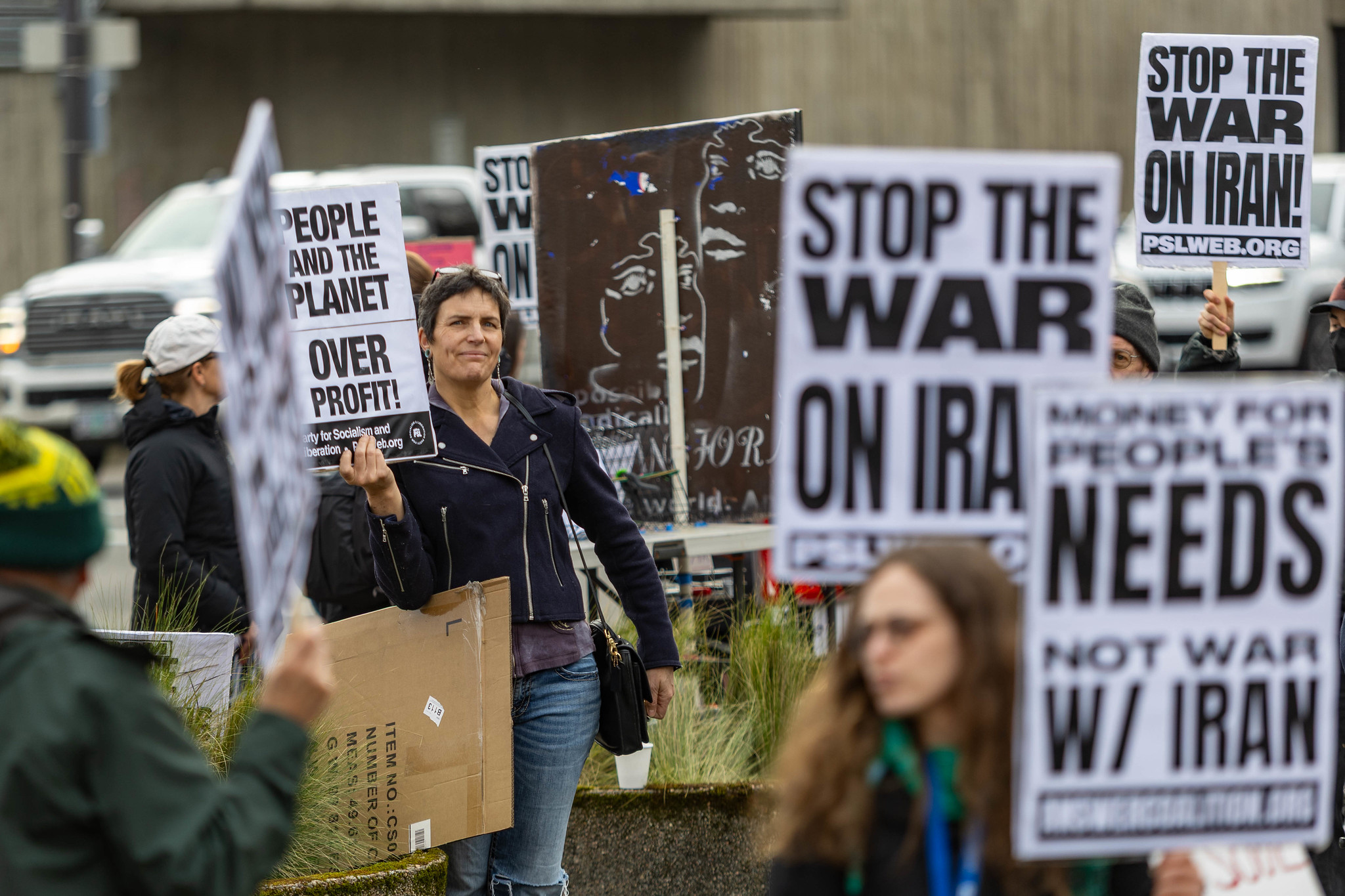
March 5, 2026 –It has been less than one week since US and Israeli air strikes on Iran plunged the Middle East, and indeed, the rest of the world, into a tense, twisting and evolving conflict involving countries near and far from the Persian Gulf.
In six short days, Iran’s supreme leader has been killed, proxy wars have begun, millions of expatriates are desperately trying to flee the region, and America’s traditional allies have been choosing between commendation, condemnation, and military co-operation.
New polling from the non-profit Angus Reid Institute finds nearly half of Americans (47%) oppose the air strikes on Iran, with one-in-three in support and, notably, one-in-five unsure (21%). Those who identify as a part of the MAGA base are near unanimous in their support (85%) while non-MAGA Republicans are more hesitant but still supportive at a slight majority level (56%). Support among Democrats (11%) and Independents (11%) is meagre.
A portion of the MAGA base draws the line at the inclusion of ground troops in this conflict. Opposition rises from two per cent for air strikes to 17 per cent when considering American soldiers with their boots down in Iran. Among non-MAGA Republicans, this idea creates significant division, with two-in-five showing support and the same number opposition (38%). Among democrats and independents, opinion tilts fully the other way, with massive majorities opposed.
As to whether this war will improve the security situation for either Iran or the United States, there is no consensus.
One-quarter (26%) say they believe the U.S. will be safer after what is being called Operation Epic Fury. A larger group say this will lead to less safety for the country (39%). A similar split is found when asking Americans if they think Iran will be better (25%) or worse off (34%). In this case, many aren’t sure (27%).
As the war approaches the one-week mark, many are speculating as to just how long it will last. Communication from the White House has been inconsistent about the timeline, but the idea floated by President Donald Trump that it could last four to five weeks appears unlikely to most. Just one-in-ten Americans say they expect that one month will be enough time to conclude operations. Larger groups say they expect it to take between one month and a year (34%) or longer than a year (31%). One-quarter say they simply don’t know.
After securing a second term in office in November 2024, President Donald Trump told supporters during his victory speech that he wasn’t going to start wars, “I’m going to stop wars”.He doubled downin his inaugural address several months later: “We will measure our success not only by the battles we win but also by the wars that we end – and perhaps most importantly, the wars we never get into.” As of February 28, the United States has entered into war with Iran, leading many to wonder how his base would respond.
Overall, Americans oppose (47%) more than support (32%) the air strikes, but these opinions are sharply defined by politics. Republicans who identify with the MAGA movement are overwhelmingly supportive (85%) of the attacks on Iran. A majority of non-MAGA identifying Republicans agree (56%), but by a far lower margin. On the other side, most Democrats (74%) and Independents (62%) oppose the military action:
Analysts say it would be difficult, if not impossible, to bring down the Iranian system with US-Israeli air power alone. Trump has said he would deploy ground troops in Iran “if necessary”, but so far the United States has not taken that step.
Source: Drudge Report
