In our preview of today's preliminary benchmark revision of US jobs - published by the BLS 'conveniently' just as Kevin Warsh started to speak - we said that according to Goldman calculations, for the first time in 3 years and just the second time since 2018, the BLS was going to revisedpayrolls modestly higher "based on the nine months of data released since the last benchmarked period, March 2025."
Specifically, Goldman's economists expected "a preliminary upward revision on the order of 50-450k which would translate to a 5-40k upward revision to monthly payroll growth over April 2025-March 2026. A final revision of this magnitude would result in the average pace of payroll growth over April 2025-March 2026 being revised up from about 25k/month currently to 30-65k/month."
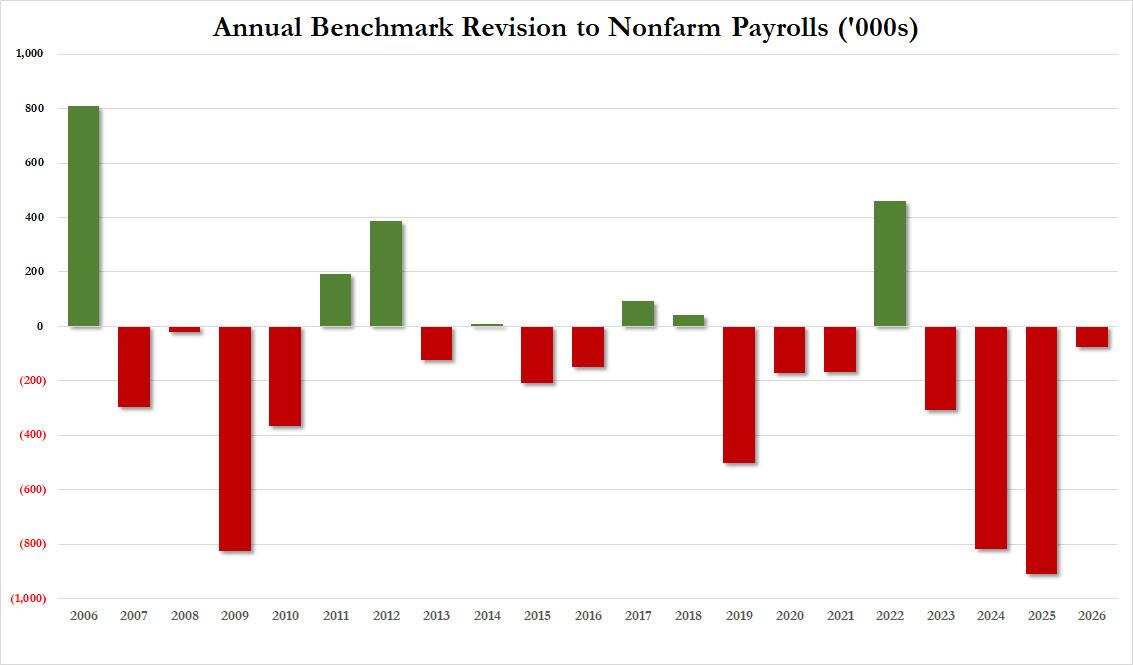
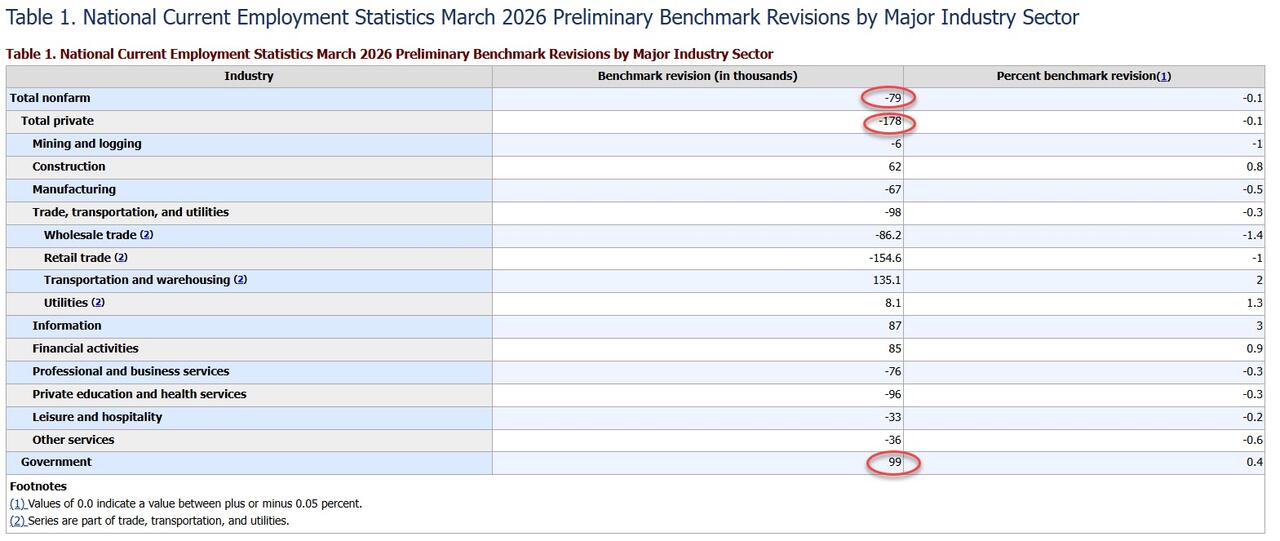
Alas, for one more year, it was not meant to be, and this morning the BLS announced that according to the preliminary estimate of the Current Employment Statistics (CES), the 2026 benchmark revision to total nonfarm employment for March 2026 was -79,000. While just why of a positive revision, it was a far cry from last year's record 911K negative job revision. For context, annual benchmark revisions over the last 10 years have had absolute average of 0.2% of total nonfarm employment.
Additionally, the revision for total private employment was -178,000, which means that government jobs were revised higher by 99K.
The 178,000 negative revision for private payrolls in the year through March reflected weakness in retail trade, education a