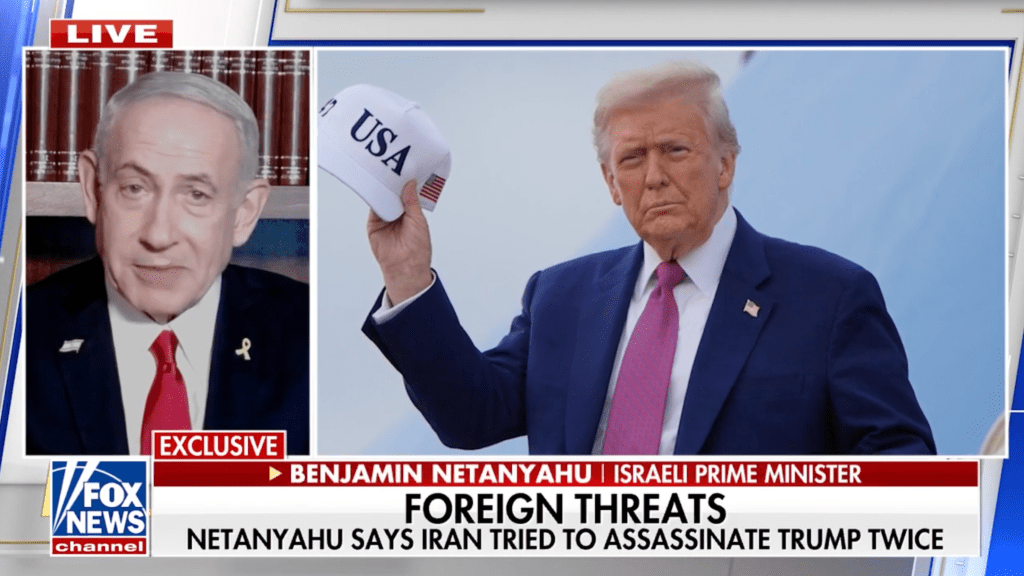
“I got him before he got me,” an ebullient President Donald Trumpremarkedto a reporter when asked about his motives for authorizing the killing of Iran’s Leader, Ayatollah Ali Khamenei, on February 28, 2026.
With his off-the-cuff remark, Trump revealed that anxiety about his own assassination at the hands of Iranian agents influenced his decision to initiate a US-Israeli regime change war that has already resulted in American casualties, the bombings of schools and hospitals inside Iran, devastating Iranian retaliatory strikes on US military bases and embassies, and a spiraling global economic crisis.
Trump’s generalized fears of assassination were well-founded. He was nearly killed in Butler, Pennsylvania on July 13, 2024 by a 20-year-old engineering student named Thomas Crooks who managed to fire eight rounds at the former president from a rooftop, slicing his ear and missing his head by a hair’s breadth. Two months later, a drifter named Ryan Routh was arrested after hiding for hours in the shrubbery outside the former president’s Mar-a-Lago estate in West Palm Beach, Florida. Routh had been spotted after pointing an assault rifle toward a Secret Service agent asTrumpplayed golf 400 yards away.
Officials have yet to produce any evidence that Iran played a role in either of these attempts on Trump’s life. Yet since those fateful events, Israel-aligned Trump advisors, Israeli intelligence, and Israeli Prime Minister Benjamin Netanyahu himself have gone to extreme lengths in order to tie Tehran to the plots. More shocking still is the fact that the FBI has manufactured a series of assassination plots, successfully convincing Trump that Iran was hunting him on US soil with highly sophisticated teams of hit men.
The man accused of leading the most significant of these operations, Asif Merchant, is currently on trial in a Brooklyn, NY federal court. After the US granted him a visadespite his presence on a terror watchlist, Merchant was in the constant company of an FBI confidential informant who ultimately steered the contrived plot to its conclusion. He never stood a chance of realizing his plans, and did not appear serious about doing so.
Independent journalist Ken Silva puts it succinctly in his forthcoming investigative book,“The Trump Assassination Plots”: “A closer look at the Merchant case reveals that at the very least…it was a highly controlled FBI sting operation that never posed a threat to Trump. More nefariously, records and whistleblower disclosures indicate that Merchant may have been the patsy in a case totally fabricated by the undercover agents.”
Authorities arrested Merchant on July 12, 2024 – just one day before Crooks attempted to kill Trump in Butler. Hours after the failed Butler assassination, FBI agents interrogated Merchant about whether it was in fact Iran that had Crooks under its control.
At that point, Trump was still campaigning to be a “President of Peace. On the campaign stump, hewarnedthat his opponent, Kamala Harris, “would get us into World War III guaranteed.” Trumpvowedto resolve the war between Ukraine and Russia in one day, anddistancedhimself from pro-war Republicans who sought regime change in Iran.
Pro-war elements in Trump’s coterie exercised multiple points of leverage to reverse the president’s anti-interventionist instincts. Ultra-Zionist billionaires supplied vital and well-documented influence over Trump’s policies by keeping his campaign war chest flush. But Trump remained an erratic personality whose petty grievances kept his aides in a perpetual state of uncertainty.
It was only by exploiting Trump’s deepest psychological vulnerability – his fear of an assassin’s bullet – that Israel and its cutouts in his administration were able to secure their influence over the president, keeping him on the warpath against Iran.
Source: The Grayzone
