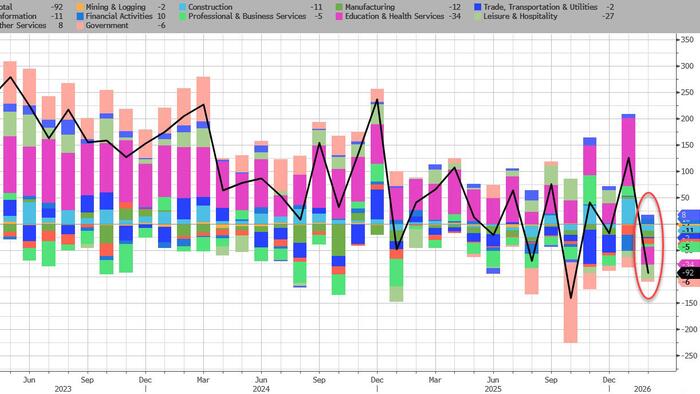
In our nonfarmpayrolls preview, we quoted JPMorgan's Market Intel desk which said that "for this print, the stronger the better", which by implication means that a poor number would be bad. By that logic, the actual numbercouldn't be any worse,because moments ago the BLS reported that in February,the US lost 92,000 jobs, a huge drop from the downward revised (of course) 126K in January, and the second worst print since 2020 (only October's shock -140K was worse), and this time, the massive drop can’t be dismissed as a one-time drop in government payrolls.The number ofprivatepayrolls dropped by 86K, also a huge miss to estimates of a 60K increase.
The February payrolls print was a six-sigma miss to the 55K median estimate, and came in 83K below the lowest estimate!
The change in total nonfarm payroll employment for December was revised down by 65,000, from +48,000 to -17,000, and the change for January was revised down by 4,000, from +130,000 to +126,000. With these revisions, employment in December and January combined is 69,000 lower than previously reported.
On a nonseasonally adjusted basis, 563k jobs were added in February, lower than the BBG estimate of 800k. An important driver of the jobs miss was the revised birth-and-death model,which contributed only 90k to February’s nonseasonally adjusted estimate. That compares with 136k last February and 151k in February 2024.
One potential mitigating factor: the number of people who were unable to work due to weather surged to 228K in February, well above last year's level 167K, due to the powerful winter storms hitting the US.
Looking under the surface does not reveal as silver lining:part-time workers dropped by 249K while full-time workers slid by 100K.
Perhaps the only silver lining was that native-born workers jumped by 877K (which was only a modest reversal of the 2.5 million drop last month), while foreign born workers dropped by 394K.
The unemployment rate rose from 4.3% to 4.44% vs estimates of an unchanged print, as the number of unemployed workers rose by 203K from 7.368MM to 7.571MM, while the civilian labor force was virtually unchanged (from 170.564K to 170.483K). Notably,the increase in unemployment was driven by an increase in the U-2 rate – those who lost their jobs – which went from 2.05% in January to 2.12% in February.
Both the labor force participation rate, at 62.0% (below the estimate of 62.5%), and the employment-population ratio, at 59.3%, changed little in February. These measures showed little change over the year, after accounting for the annual adjustments to the population controls.
Turning to wages, average hourly earnings rose 0.4% MoM, same as January and above estimates of a 0.3% imcrease. This translated into a 3.8% YoY increase, up from 3.7% and the consensus of an unchanged print.
Source: ZeroHedge News
