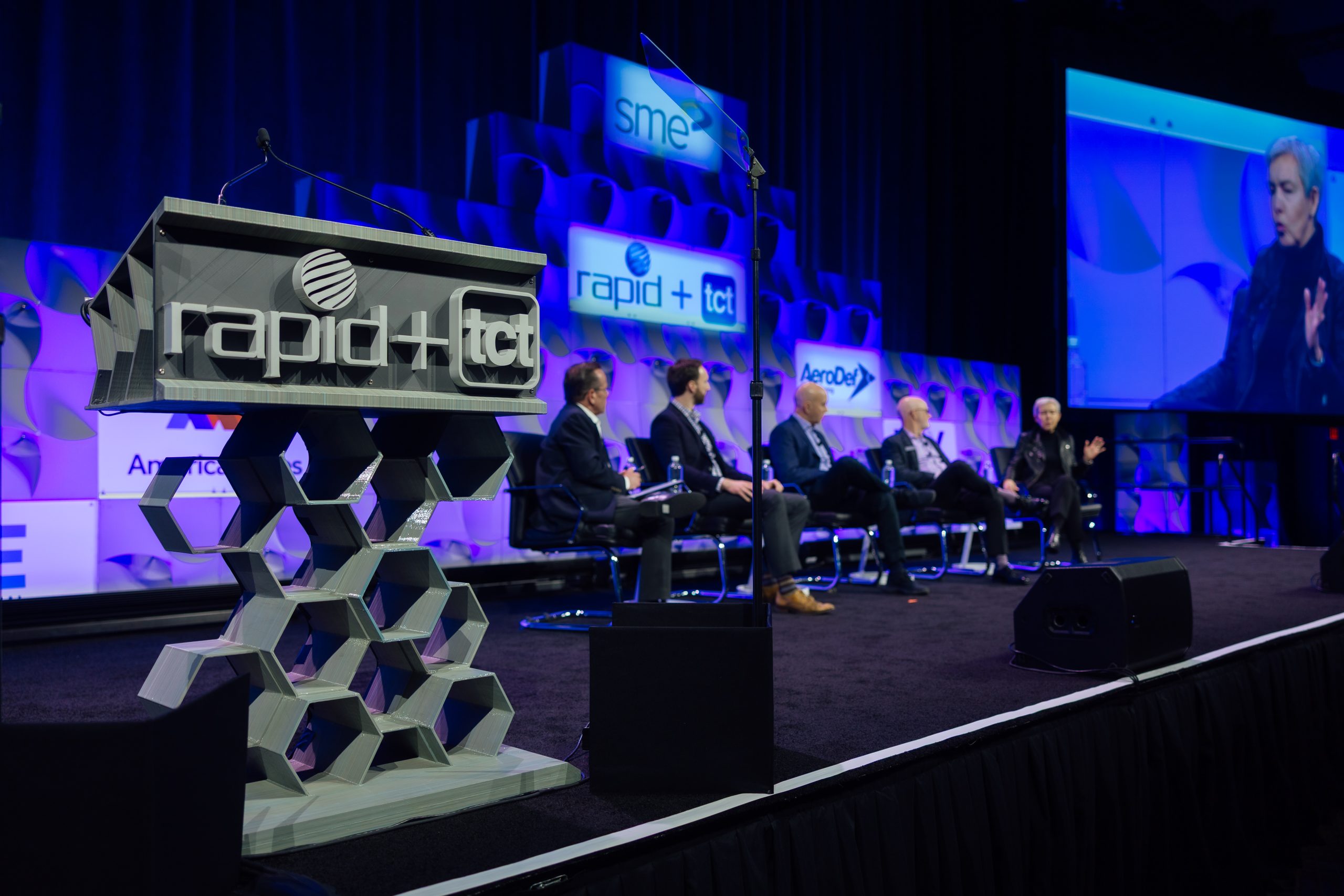
Ask anyone who has attendedRAPID + TCTacross multiple years what keeps them coming back, and the answers converge on the same thing: the calibre of conversation the event makes possible. Engineers talk to executives. Researchers talk to operators. People who rarely share a room find themselves sharing a problem.
The newly introducedEssential AM trackin the 2026 conference is designed around that same principle. Spanning design for additive manufacturing (DfAM), post-processing, standards, repeatability, AI, and business case development, it is deliberately cross-sector rather than industry-specific.
Running from 13 to 16 April, the conference program is open to practitioners from any sector working through the harder questions, both before and after a successful build. The show floor and expo opens the following day, the 14th.
Attend RAPID + TCT this April in Boston as a guest of 3D Printing Industry!Claim your free Expo Pass or save 20% on a Conference Pass.
Ahead of the event, I asked three of the track’s speakers to discuss what past attendance at the conference has meant for their work, and what they are bringing to RAPID + TCT 2026 in Boston this year.
Cost-Driven Planning: Maximizing Profit in Additive Manufacturing – Huba Horompoly, Co-Founder and Managing Partner,Gravity Pull Systems
Horompoly has a particular way of describing what RAPID + TCT does well, as he explains, “RAPID + TCT is one of the few places where you can talk to everyone in the value chain in two days: machine OEMs, service bureaus, aerospace, medical primes, software vendors, and researchers. That environment forces you to connect the dots.”
For the Co-Founder, those dots kept pointing toward the distance between what an engineering team considers a success and what a production environment can actually sustain. Qualification requirements, post-processing bottlenecks, scheduling constraints, the unglamorous calculus of build vs. make decisions. None of it features heavily in the technical literature, but all of it determines whether a promising AM application ever scales.
That realisation shaped the architecture of Gravity Pull Systems directly. PAAM handles toolpath and parameter optimisation at the print level; SYNOPTIK takes the wider view, covering scheduling, material planning, post-processing capacity, and real-time replanning. The two platforms are built as a pair because, in Horompoly’s experience, improving one in isolation means the gains from the other are never fully realised.
His session in Boston will address a question the industry has been circling without quite resolving: why does cost keep surprising even experienced AM teams. He explains AM cost is not a single figure but a system with interdependencies that standard estimating models tend to flatten.
Source: 3D Printing Industry
