The rhythm of American life changes significantly when the workweek ends.
Weekends and holidays bring more time for rest, recreation, chores, and social connections. At the same time, work and education occupy a much smaller share of the day.
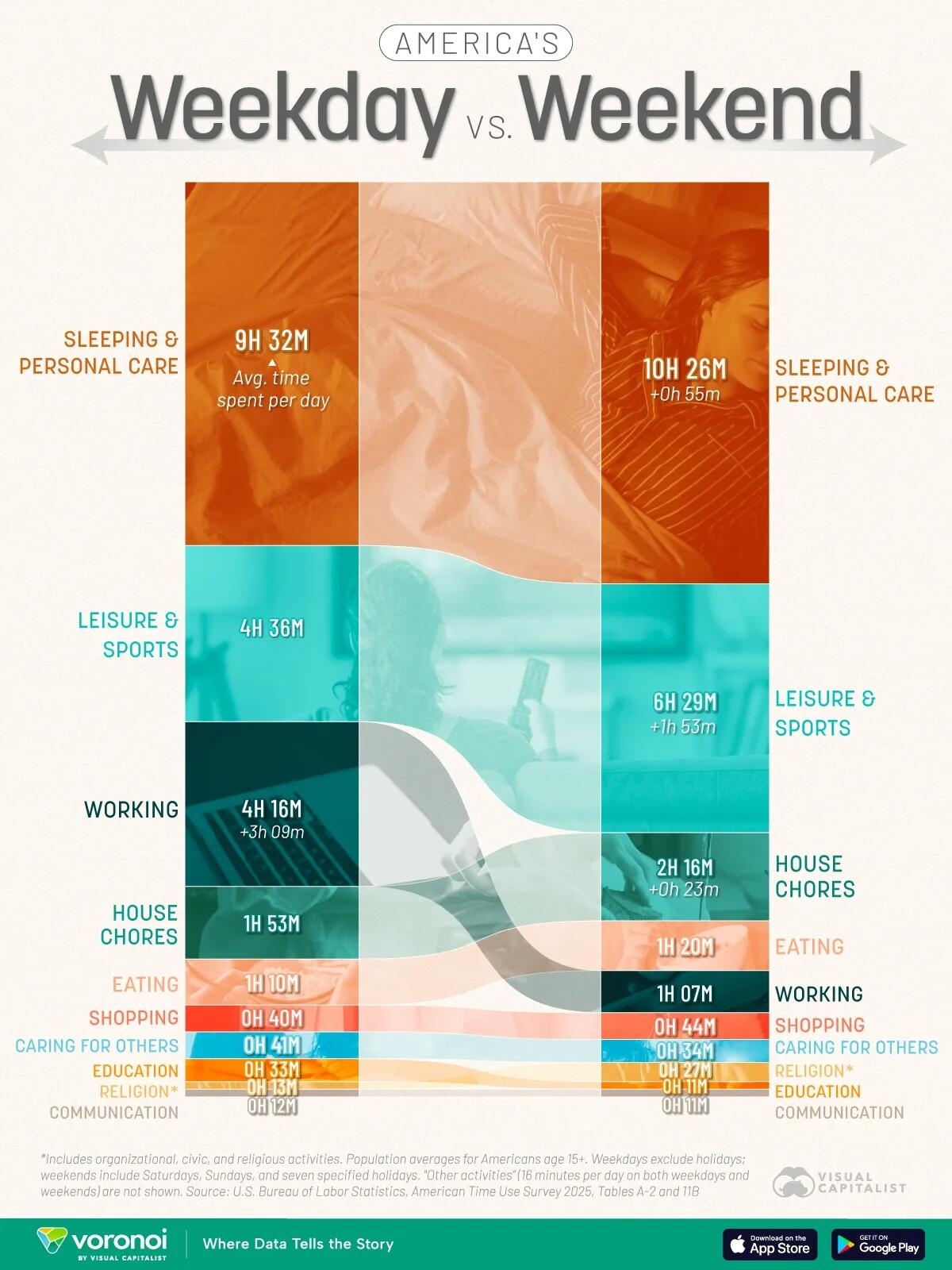
This visualization, via Visual Capitalist's Niccolo Conte, shows how Americans aged 15 and older redistribute their time between weekdays and non-workdays.
The data for this visualization comes from the U.S. Bureau of Labor Statistics’ American Time Use Survey.
Work Gives Way to Free Time
Work accounts for the largest shift in Americans’ schedules. Time spent working and on work-related activities falls from 4.26 hours per weekday to 1.11 hours on weekends and holidays, a decline of 3.15 hours, or 189 minutes.
How Americans Spend Time Weekday Weekend Change (h m) Sleeping 9h 32m 10h 26m +0h 55m Leisure & Sports 4h 36m 6h 29m +1h 53m Working 4h 16m 1h 07m -3h 09m House Chores 1h 53m 2h 16m +0h 23m Eating 1h 10m 1h 20m +0h 10m Shopping 0h 40m 0h 44m +0h 04m Caring for Others 0h 41m 0h 34m -0h 07m Education 0h 33m 0h 11m -0h 22m Religion 0h 13m 0h 27m +0h 14m Communication 0h 12m 0h 11m -0h 01mEducational activities also decrease, falling from 0.55 hours to 0.18 hours per day.
Meanwhile, leisure and sports increase from 4.60 hours on weekdays to 6.48 hours on weekends and holiday