JPMorgan is the latest institutional research desk to warn that the next global food crisis may already be taking shape, driven by what its analysts describe as the "Five Ws": War, Weather, Warehousing, Water, and Waste.
In a new report titled Food Security Is National Security: A Compounding Storm, a team led by London-based senior global economist Nora Szentivanyi warned that disruptions around the Strait of Hormuz and the emergence of a potentially historic El Niño could weaken crop yields, constrain agricultural production, and keep food inflation elevated through the first half of 2027.
"Successive shocks since COVID have compounded, eroding food production capacity and keeping food price pressures elevated into 2027," Szentivanyi said, warning that "this is not a short-lived shock; it has reduced the likelihood of near-term disinflation, and the food inflation cycle is likely to exert pressure through 1H27."
She expects global food inflation to accelerate from 2.8% in the first half of 2026 to 5% in the first half of next year.
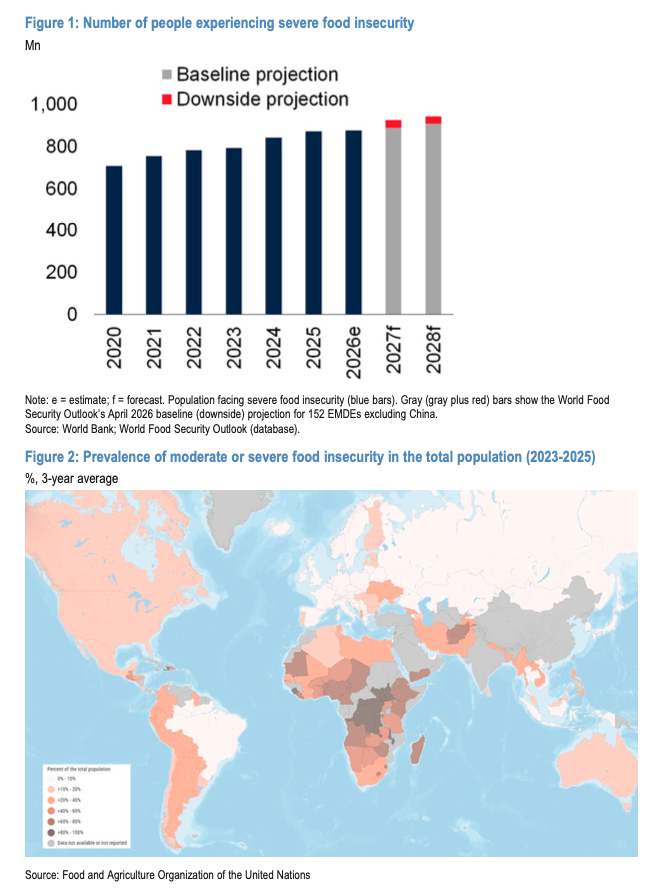
The warning comes despite a modest improvement in hunger statistics. About 645 million people faced hunger in 2025, down roughly 43 million from 2022. Yet 2.1 billion people, or 25.8% of the global population, still experienced moderate or severe food insecurity.
Szentivanyi outlined the most immediate vulnerability: fertilizer. She noted, "Disruptions in the Strait of Hormuz and the coming super El Niño are adding to fertilizer and food price pressures."