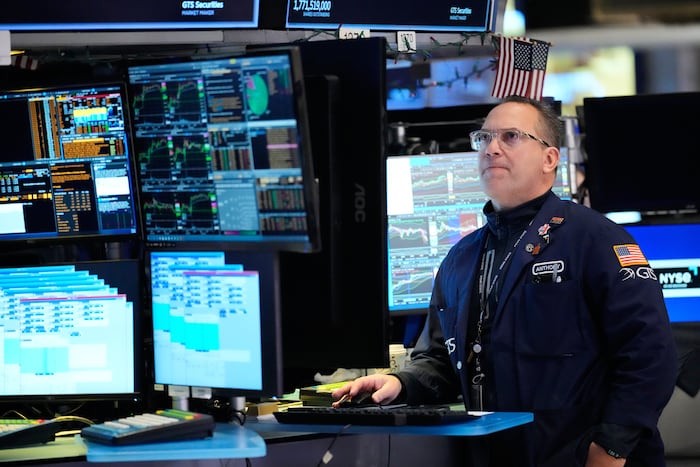
NEW YORK (AP) — Stocks sank on Wall Street Thursday after the price of oil spiked to its highest level since the summer of 2024 because of the war with Iran.
The S&P 500 fell 0.6% and erased what had been a small gain for the year so far. The Dow Jones Industrial Average briefly dropped more than 1,100 points before finishing with a loss of 784, or 1.6%. The Nasdaq composite slipped 0.3%.
The losses came as financial markets around the world keep following the cue of oil prices. Sharp increases there are raising worries that a long-term surge could grind down the global economy, exhaust households’ ability to spend and push interest rates higher.
The price for a barrel of benchmark U.S. crude shot up 8.5% Thursday to settle at $81.01 per barrel. Brent crude, the international standard, climbed 4.9% to $85.41 per barrel and is likewise near its highest price since 2024.
Oil prices gave back some of those gains later in the day, which helped stocks in the U.S. moderate their losses at the end of trading. But worries nevertheless remain high about how long disruptions will last for oil production because of the escalating war with Iran.
Prices at U.S. gasoline pumps have already leaped because of them. The average price for a gallon is $3.25, up 9% from $2.98 a week ago, according to auto club AAA.
If oil prices spike further, like to $100 per barrel, and stay there, some analysts and investors say it could be too much for the global economy to withstand. Uncertainty about what will happen has caused frenetic swings across financial markets this week, sometimes hour by hour.
Much will depend on what happens with the Strait of Hormuz. Roughly a fifth of the world’s oil typically sails through the narrow waterway off Iran’s coast.
To be sure, the U.S. stock market has a history of bouncing back relatively quickly following conflicts in the Middle East and elsewhere, as long as oil prices don't jump too high for too long. That has many professional investors suggesting patience and riding through the market’s swings.
“While further escalation remains a risk, we think the more likely outcome is an increase in market risk aversion that likely lasts only a short time until investors can see a winding down of hostilities,” according to Scott Wren, senior global market strategist at Wells Fargo Investment Institute.
Source: WPLG
