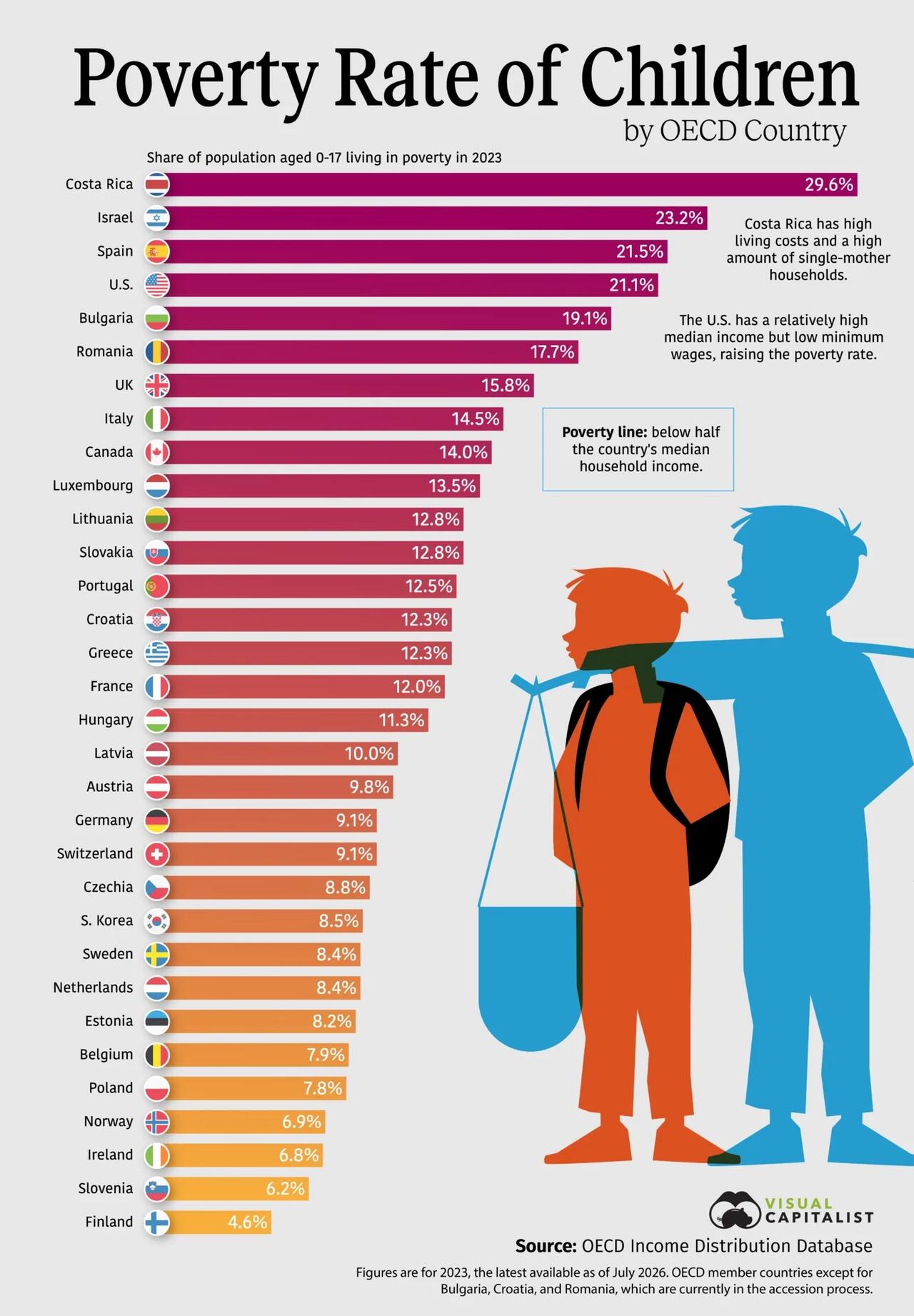
Child poverty rates vary widely across OECD economies, ranging from less than 5% in Finland to nearly 30% in Costa Rica.
This visualization, via Visual Capitalist's Melissa Garside, ranks OECD countries by the share of children ages 0–17 living below the poverty line in 2023. The poverty line is defined as half the median household income of the total population, meaning the measure is relative to living standards within each country. As a result, countries with the same poverty rate can differ in the absolute income levels of households classified as poor.
The data for this visualization comes from the OECD Income Distribution Database. It presents 2023 data, the latest available as of August 2026, covering OECD member countries as well as Bulgaria, Croatia, and Romania, which are currently in the accession process.
Costa Rica Has Highest Child Poverty Rate in OECD
Costa Rica stood well above the rest of the ranking. Its 29.6% child poverty rate was 6.4 percentage points higher than Israel’s, the next-highest country at 23.2%.
High living costs and a large informal labor market are among the factors that can leave households with children particularly vulnerable to poverty.
RankCountryLiving Below the Poverty Line(%, Ages 0-17) 1🇨🇷 Costa Rica29.6 2🇮🇱 Israel23.2 3🇪🇸 Spain21.5 4🇺🇸 United States21.1 5🇧🇬 Bulgaria19.1 6🇷🇴 Romania17.7 7🇬🇧 UK15.8 8🇮🇹 Italy14.5 9🇨🇦 Canada14.0 10🇱🇺 Luxembourg13.5 11🇱🇹 Lithuania12.8 12🇸🇰 Slovakia12.