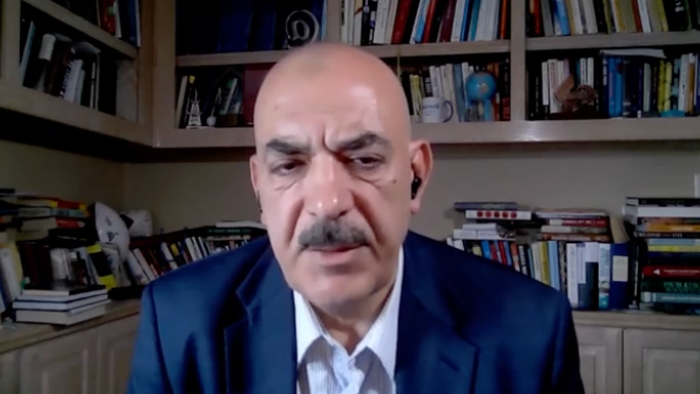
It is only the sixth day ofOperation Epic Fury, and roughly the fourth or fifth day that commercial traffic through the Strait of Hormuz has been paralyzed (except for one Chinese-linked bulk carrier), whether by IRGC drone threats or by insurers suspending vessel coverage, and already energy economist Anas Alhajji warned on a webinar with top UBS analysts that "if this is going to last for four weeks, that's where things will be completely out of control."
Bhanu Baweja, Chief Strategist at UBS, asked Alhajji on the webinar: "How many days would the Strait of Hormuz need to remain shut for us to see a non-linear move in oil, with prices rising to $100 or $120 per barrel? Is there a timeline you can give us?"
Alhajji responded, "Our main scenario is that if this lasts four weeks, things will be completely out of control. And when I say out of control, I mean that even if China starts releasing oil from its inventories, the problem is that my guess is China would also restrict exports, which means that oil would remain in China. We were counting on that oil being in the market, and now it is not going to be in the market."
He continued, "The impact of the U.S. SPR is limited. Saudi Arabia is completely out of the picture. All of that spare capacity in OPEC is out of the picture. So what do we do? We are then left relying on demand destruction to curb prices. And because of the panic buying, prices would go above $100 easily in this scenario."
Alhajji warned about panic hoarding in the oil market. He said he questioned back in January why the Trump administration was hoarding Venezuela's oil after the Maduro raid, instead of bringing it to market.
Alhajji then emphasized, "I'm not talking about conspiracy theories. We were criticizing the Trump administration, companies, and trading houses that bought Venezuelan oil, and asking why they weren't able to sell it to end users and why they were hoarding it. Now we know." He was implying that this hoarding was in preparation for Operation Epic Fury.
Earlier in the webinar, Alhajji outlined critical questions:
Is the war about Iran's nuclear program, or is something much larger at play, with Iran serving more as a trigger or for broader strategic objectives?
The distinction matters significantly because the medium- and long-term outcomes would look very different.
Should attention be focused narrowly on Iran's nuclear program and regime change, or should the situation be analyzed within the much wider context of China, trade wars & tariffs, AI competition, Panama Canal, Red Sea, Venezuela, Syria, & Greenland?
Source: ZeroHedge News
