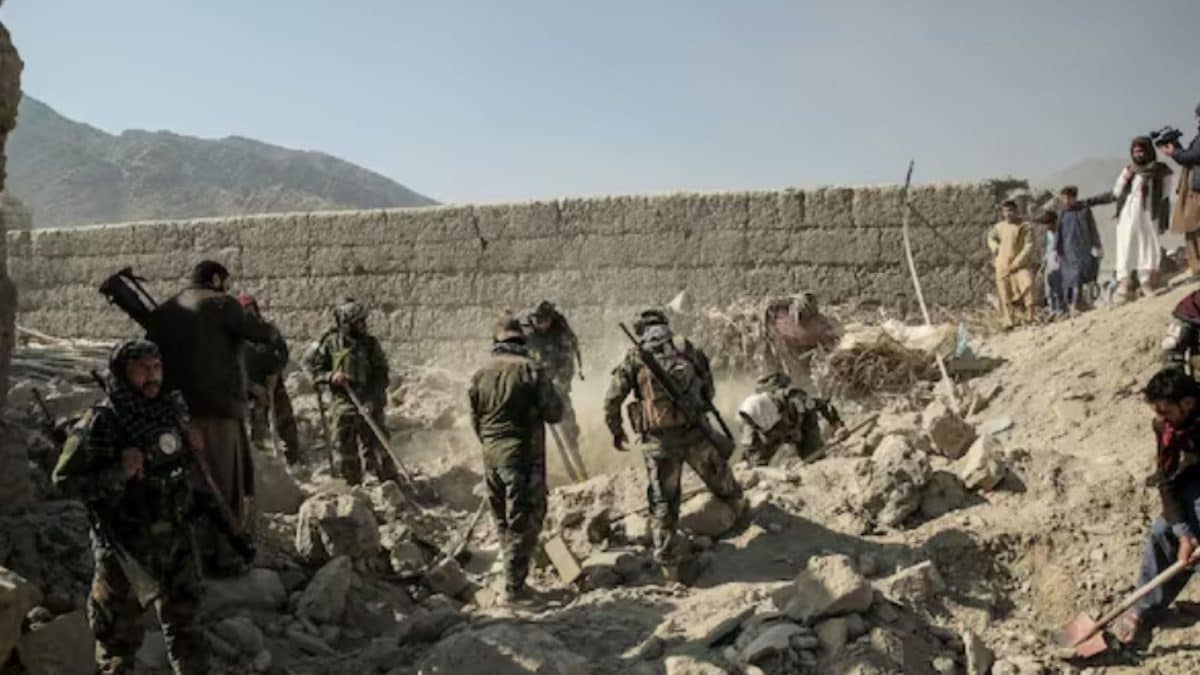
In a dramatic escalation of the “open war" along theDurand Line, sources within the Afghan Taliban’s Ministry of National Defence have claimed to CNN-News18 a series of devastating military successes against Pakistani security forces. The Taliban administration asserts that its forces have launched synchronised, multi-province strikes across Kandahar, Nangarhar, Kunar, Nuristan, Khost, Paktika, and Paktia, effectively dismantling a significant portion of Pakistan’s forward defensive crust.
According to a spokesperson for the Taliban’s Ministry of Defence, Sediqullah Nusrat, the overnight operations have resulted in the deaths of at least 41 Pakistani soldiers in the last 24 hours alone, with over 53 others wounded. These figures suggest a casualty rate significantly higher than initially reported by Islamabad, indicating that the ground reality forPakistani troopsis increasingly precarious.
https://images.news18.com/ibnlive/uploads/2026/03/Spokesperson-for-the-Talibans-Ministry-of-Defence-Sediqullah-Nusrat-2026-03-c66d4d3efa1a22636ad897e62de43f9e.mp4
The Taliban’s offensive appears to be a direct and calculated response to Pakistan’s “Operation Ghazab-ul-Haq." While Pakistan has relied heavily on aerial strikes targeting alleged TTP hideouts in Kabul and Kandahar, the Taliban have focused on high-intensity ground assaults. Reports now indicate that between 19 and 27 Pakistani border posts have been either captured or completely destroyed in recent engagements.
The loss of these outposts, particularly in the Spin Boldak district of Kandahar and the Ali-Sher district of Khost, has exposed critical vulnerabilities in Pakistan’s forward defences. Taliban fighters have reportedly seized heavy military equipment and ammunition, showcasing their ability to not only repel Pakistani incursions but to actively seize and hold territory along the porous 2,600-km border.
Despite the Pakistan Air Force’s intensive bombardment of targets in Jalalabad and the Bagram air base, the Taliban claim to have maintained their operational momentum. Afghan sources report that their air defence units successfully shot down three Pakistani reconnaissance drones over the past day, blunting Islamabad’s intelligence-gathering capabilities.
The ground clashes have proven particularly lethal for Pakistani forces. While Information Minister Attaullah Tarar has claimed hundreds of Taliban casualties, theTalibancounter-narrative—supported by local reports from the frontline—suggests that Pakistan is suffering higher-than-expected losses in close-quarter combat. The Taliban-run state broadcaster, RTA, even claimed retaliatory “airstrikes" by Afghan forces on Pakistani Frontier Corps command centres in Kuchlak and Quetta, bringing the theatre of war deep into Balochistan.
This military humiliation on the border comes as Pakistan grapples with a systemic failure of its internal security apparatus. The Taliban have consistently maintained that the Tehrik-e-Taliban Pakistan (TTP) is an internal Pakistani problem, yet the ongoing conflict has seen the TTP and other militant factions urge their fighters to aid the Afghan Taliban.
As the conflict enters its eighth day, the loss of dozens of border posts suggests that Pakistan’s military may be overstretched. The inability to secure the Durand Line against sustained Taliban counter-offensives is not just a tactical defeat; it is a strategic blow to Pakistan’s long-standing policy of “strategic depth" in Afghanistan. With the Taliban now claiming pre-delegated authority for military responses across all border sectors, the prospect of a de-escalation appears distant.
Source: World News in news18.com, World Latest News, World News
