Authored by Lance Roberts via RealInvestmentAdvice.com,
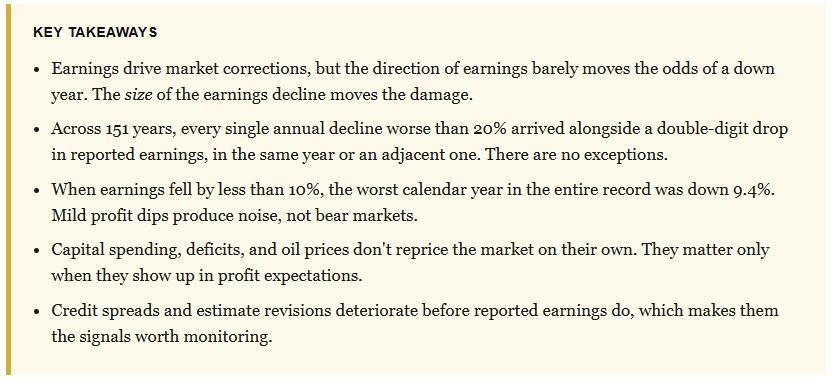
“Earnings drive market outcomes. In 151 years, every single 20% market decline was accompanied by a double-digit earnings decline, with zero exceptions.”
Every few months, a new reason to sell arrives. Capital spending is too high. The deficit is unsustainable. Oil just broke out. The conclusion attached to each is always the same: investors are about to lose half their money. I’ve watched that warning recycle for three decades, and it’s a smoke detector that goes off every time somebody makes toast. What actually matters is far less exciting. Earnings drive market corrections, and the historical record on that is close to airtight.
A probability tree from BCA Research has been circulating that makes the point simply. It shows the S&P 500 rising 84% of the time overall, and only 64% of the time in years when earnings fall. The framing is right. The specific numbers, when I rebuilt them from scratch, turned out to be a good deal more interesting than the chart suggested.
The Bear Case That Keeps Not Working
Start with why the popular scare stories fail as timing tools. Capital spending, government deficits, and energy prices are all real economic variables. None of them repriced the market on their own. If earnings drive market corrections, then every one of these stories has to travel through profits before it can do any damage, and most of them never complete the trip.
The reason is mechanical. A stock is a claim on future