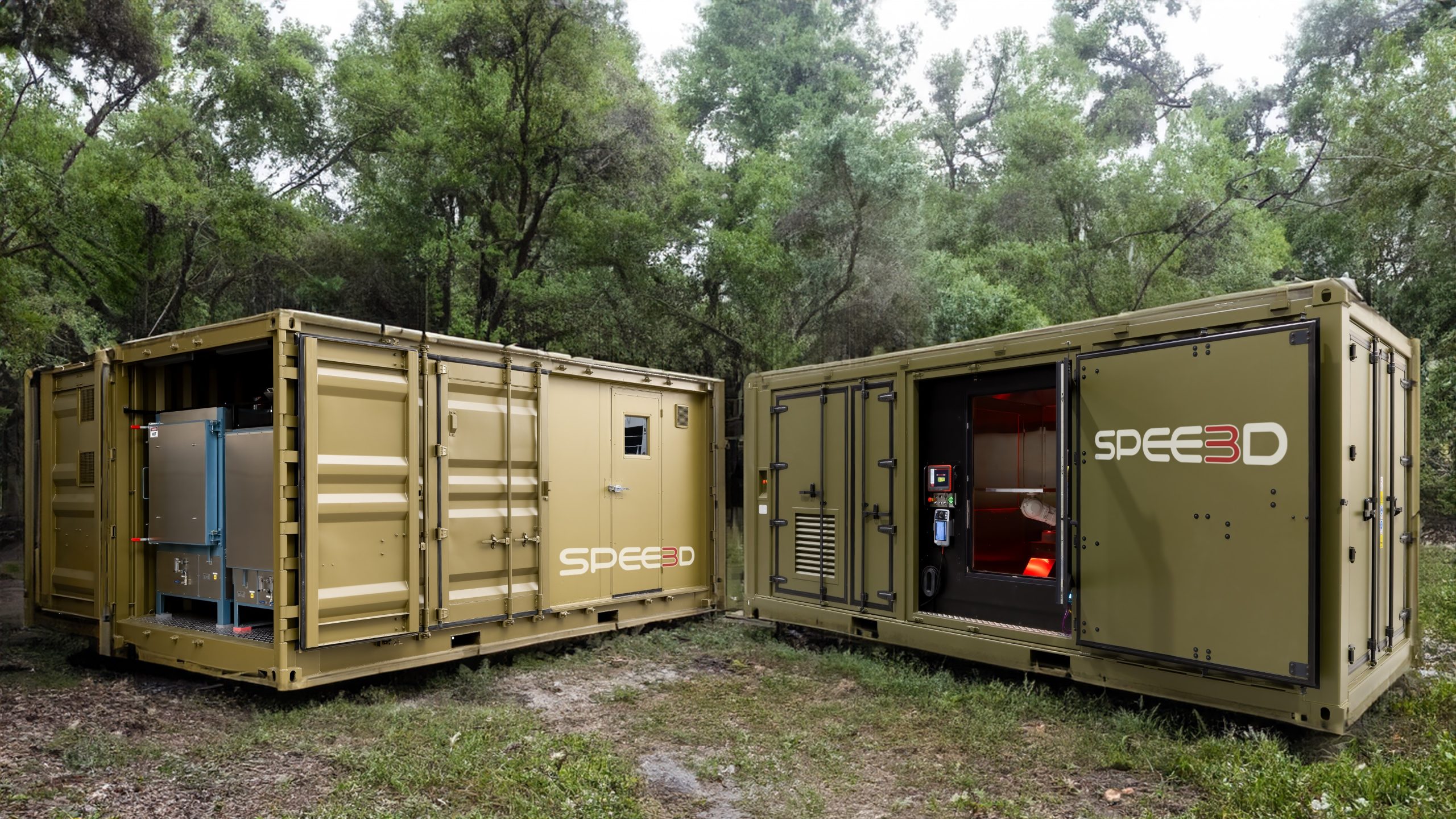
When a critical component fails in a contested environment, standardU.S. Armylogistics can take six to ten weeks to deliver a replacement, time a deployed unit cannot afford. At a Tennessee training range in February 2026, theUniversity of Tennessee‘s Defense Development and Applied Research Center (DARC), theTennessee Army National Guard, andDEVCOM Army Research Laboratory(ARL) proved a faster path is possible. UsingSPEE3D‘s deployable cold spray metal additive manufacturing technology, the team produced a mission-critical vehicle part in under ten hours, delivered it by drone, and trained soldiers to run the entire process themselves.
The initiative was recognized atMILAM 2026in Tampa, where DARC, the Tennessee Army National Guard, and DEVCOM ARL received the Expeditionary and Tactical 3D Printing Excellence Award. The award recognizes outstanding contributions to delivering advanced manufacturing solutions at the tactical edge, driving industry and government efforts to improve warfighter readiness.
“This allows our Soldiers and maintenance leaders to help shape the Army’s future of maintaining our critical combat systems when we are deployed and in harm’s way. If we can give our Soldiers the ability to build critical repair parts in a timely manner that will help improve combat power, enhance readiness, and reduce risk and our logistics footprint that could ultimately help save Soldiers’ lives,” said Army Lt. Col. Colby Tippens, Executive Officer, 278th ACR, and senior leader within the Tennessee Army National Guard.
From Deadlined to Operational in Under Ten Hours
On the Tennessee training range, an armored combat support vehicle was pulled from service after a failed Battle Lock Handle rendered its door locking mechanism inoperable. Without the part, the crew could not safely return to base, a scenario that, across the U.S. Army, typically triggers a six-to-ten-week wait as replacement components travel from manufacturers through depots, airlifts, and convoys to reach forward units.
DARC, alongside the Tennessee Army National Guard and DEVCOM Army Research Laboratory, deployed SPEE3D’s cold spray metal additive manufacturing technology in a live mission scenario. Using the Expeditionary Manufacturing Unit, soldiers and engineers designed, printed, heat-treated, and machined a replacement Battle Lock Handle on-site in under ten hours.
To avoid routing the part through contested terrain by convoy, a drone carried it directly to the stranded vehicle, compressing what would have been a weeks-long logistics chain into a single operational day.
“Waiting weeks for a replacement part isn’t just a logistical delay, it’s a tactical vulnerability for the military,” said Byron Kennedy, CEO of SPEE3D. “Our technology is there to empower soldiers with true right-to-repair capabilities at the point of need. This demonstration is an example of how expeditionary manufacturing does not just fix vehicles but strengthens mission readiness and gets warfighters back in the fight safely and effectively.”
The trial went beyond a single repair. The team also produced a generator exhaust cover supporting MEDEVAC equipment and mounting brackets for a friendly-fire prevention display, components that would traditionally require ordering entire assemblies at a high cost.
Building the Capability, Not Just the Part
Source: 3D Printing Industry
