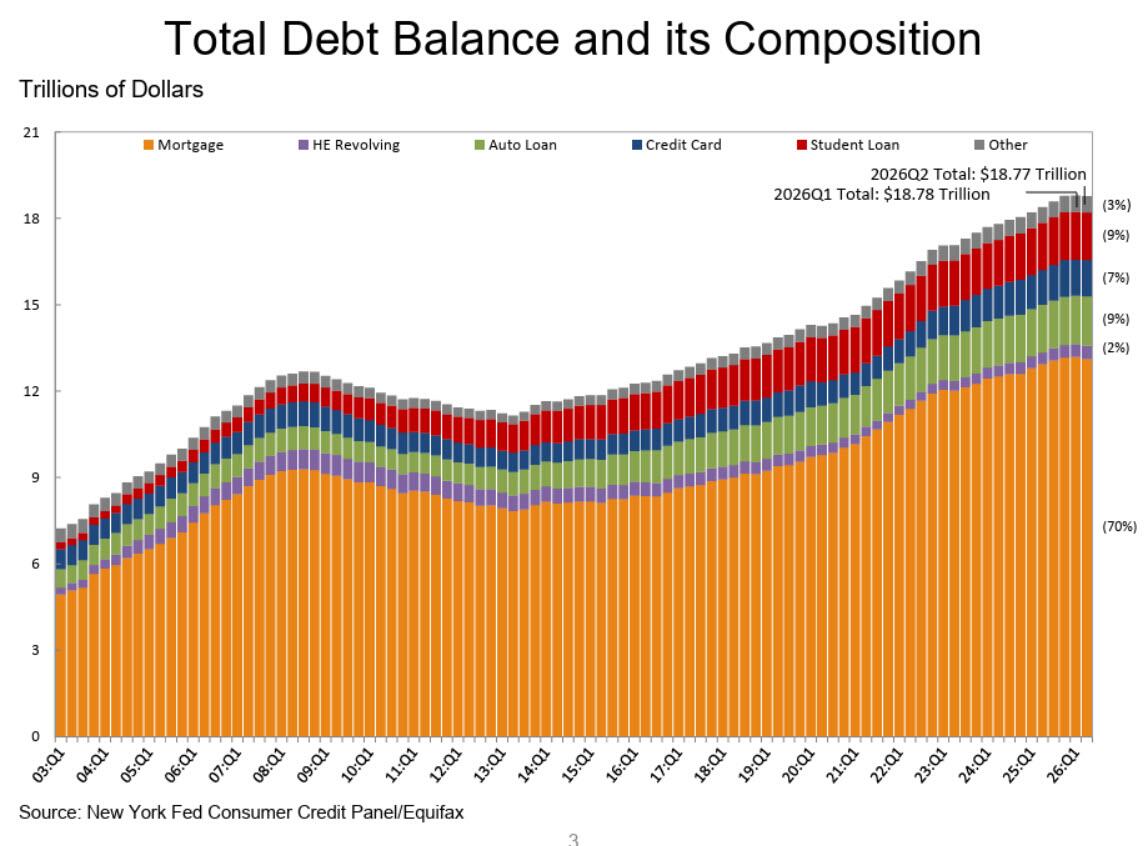
Something unprecedented happened in the second quarter: aggregate household debt balances declined by $13 billion, a 0.1% decline from Q1. Balances stood at $18.8 trillion, up $4.6 trillion since the end of 2019, just before the pandemic recession. But the reason why we say it was unprecedented, is that the Q2 drop was the first quarterly decline in total household debt since the second quarter of 2020, when the US economy was gripped by the covid lockdown shock leading to a historic deleveraging.
In fact, the only time aggregate household debt slides is during and right after periods of financial or social crisis. And yet, in Q2, risk assets soared.... which makes one wonder: just how bad is the economy really if one takes away the constant, debt-fueled (both on and off balance sheet) AI meltup?
Here is the breakdown by main category:
- Mortgage debt at $13.12t after $13.19t in 1Q, a decrease of $74b
- Mortgage delinquency rate fell to 0.99% from 1.09% prior quarter
According to the NY Fed, the decline was "due to a temporary gap in the reporting of mortgages on credit reports due to a transfer of servicing." Meanwhile, balances on home equity lines of credit (HELOC) rose by $13 billion, marking the 17th consecutive quarterly increase. Outstanding HELOC balances now total $459 billion, $142 billion above the low reached in 2022 Q1.
Non-housing debt balances, which apparently were not impacted by a tranfer transfer of servicing, grew by $48 billion, or