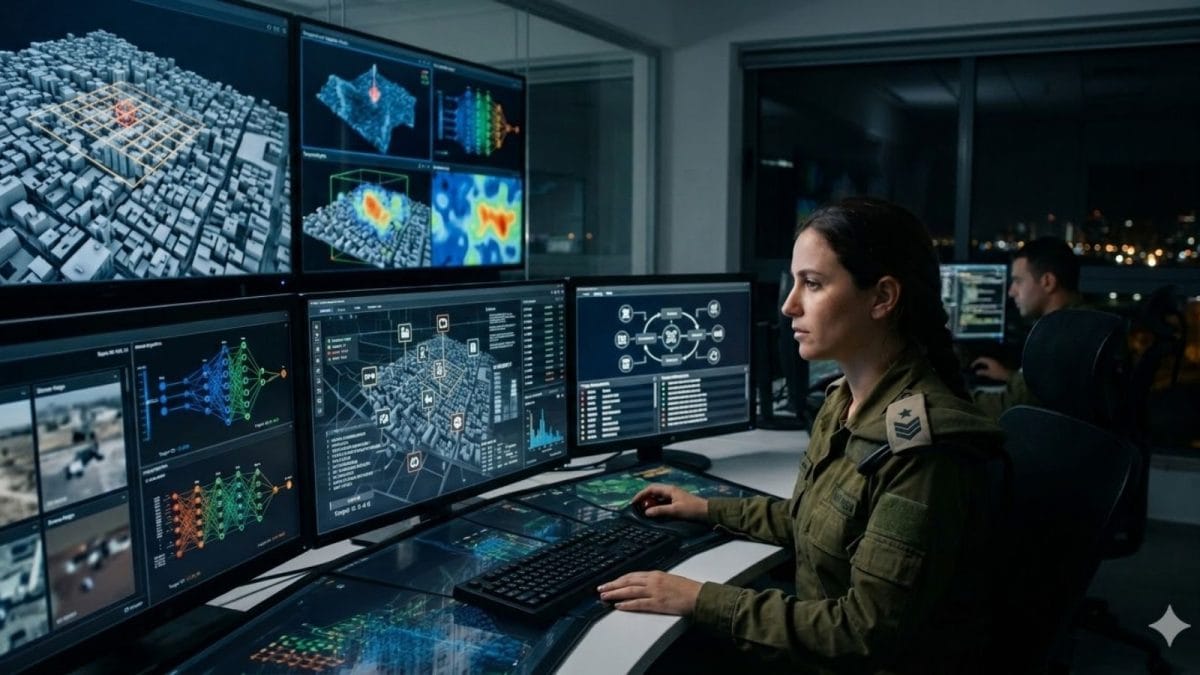
In the windowless command centers of Israel’s elite Unit 8200, the nature of combat has shifted from the tactile to the algorithmic. As the broaderWest Asia conflictintensifies, marked by recent jointUS-Israeli strikes against Iranand subsequent retaliatory barrages across the region, the reliance on automated intelligence has reached an unprecedented scale. TheIsrael Defence Forces (IDF)are currently deploying a sophisticated suite of Artificial Intelligence (AI) systems, most notably “Habsora" (The Gospel), which has transformed the identification of battlefield targets into a high-speed automated process.
While the military hails this as a breakthrough in precision and efficiency, the technology has sparked an international debate over the “automation of death" and the diminishing role of human oversight in conflict. Developed by the IDF’s signals intelligence arm, The Gospel functions as a massive data-processing engine. It ingests a near-infinite stream of information to identify military targets, such as command centers, rocket launchers, and hideouts, that would take human analysts weeks or months to verify.
The system synthesises data from four primary pillars:
The primary advantage of The Gospel is its sheer velocity. Traditionally, a team of 20 intelligence officers might identify 50-100 targets in a single year. According to military reports, The Gospel can generate over 200 precise targets in just 10-12 days.
Internal IDF sources have referred to the system as a “Target Factory", capable of suggesting approximately 100 potential strike points per day. This represents a 50-fold increase in efficiency over traditional human analysis, allowing the military to maintain a relentless operational tempo. “We work without compromise in identifying who and what the enemy is," an IDF source stated, “The machine doesn’t get tired; it doesn’t blink."
The Gospel does not operate in a vacuum. It is part of a broader ecosystem designed to automate the entire “kill chain":
While The Gospel identifies the where, a secondary system known as Lavender identifies the who. Lavender reportedly scans the data of Gaza’s 23 lakh residents, assigning individuals a score from 1 to 100 based on their proximity to known militant activity. Those with high scores are flagged for potential liquidation.
The integration of AI into warfare has drawn sharp criticism from human rights organisations and ethics experts. The central point of contention is the OODA Loop (Observe, Orient, Decide, Act). In modern digital warfare, AI accelerates this cycle so rapidly that human intervention often becomes a formality.
Critics argue that when a system generates dozens of targets a minute, the human “in the loop" becomes a mere rubber stamp, trusting the machine’s “90% accuracy" without having the time to perform a manual verification.
The “Gospel" system represents a milestone in military technology, proving that AI can dominate the modern battlefield. However, as warfare becomes increasingly “efficient," the international community is left to grapple with a chilling reality: we have entered an era where the line between a military objective and a human life is determined by a line of code.
Source: World News in news18.com, World Latest News, World News
