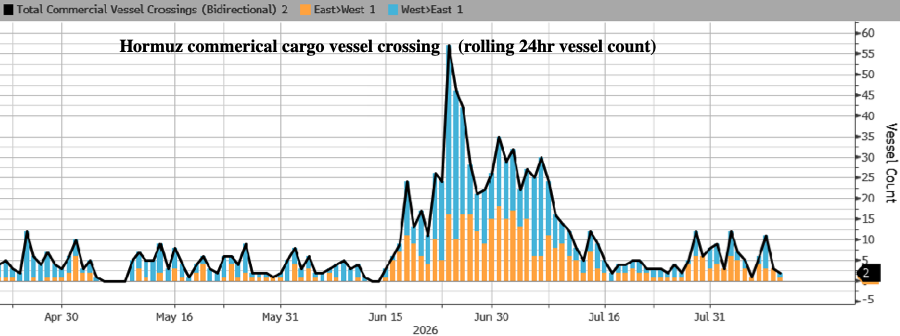
The latest Bloomberg data show that shipping transits through the Strait of Hormuz remained largely disrupted Monday morning, even as Iran and Oman reportedly moved closer to a deal.
Brent crude futures traded near $85 a barrel as markets priced in the possibility that a deal to reopen the maritime chokepoint could be imminent. Yet global supply-chain stress remains near its highest level since the pandemic, and any normalization could take months, even if shipping traffic resumes.
UBS senior international economist Pierre Lafourcade highlighted the bank's proprietary Global Supply Chain Stress Index, which showed that although pressures eased modestly in July from their highest level since the pandemic, disruptions stemming from the Hormuz chokepoint continue to strain global shipping networks.
The median reading of the bank's 23-component Global Supply Chain Stress Index fell .4 standard deviation from June but remained .9 standard deviation above its pre-Iran conflict level. The average reading declined .3 standard deviation from June while remaining 1.35 standard deviations above February, or pre-US-Iran war, levels.
Lafourcade adds more color here:
Marginal relief for supply chains relative to the June peak
With the July data now complete, our Global Supply Chain Stress Index is showing a modest easing in pressure from the June reading, which marked the highest level of stress since the pandemic. Figure 1 below shows the latest reading.
« Back to The Culture War