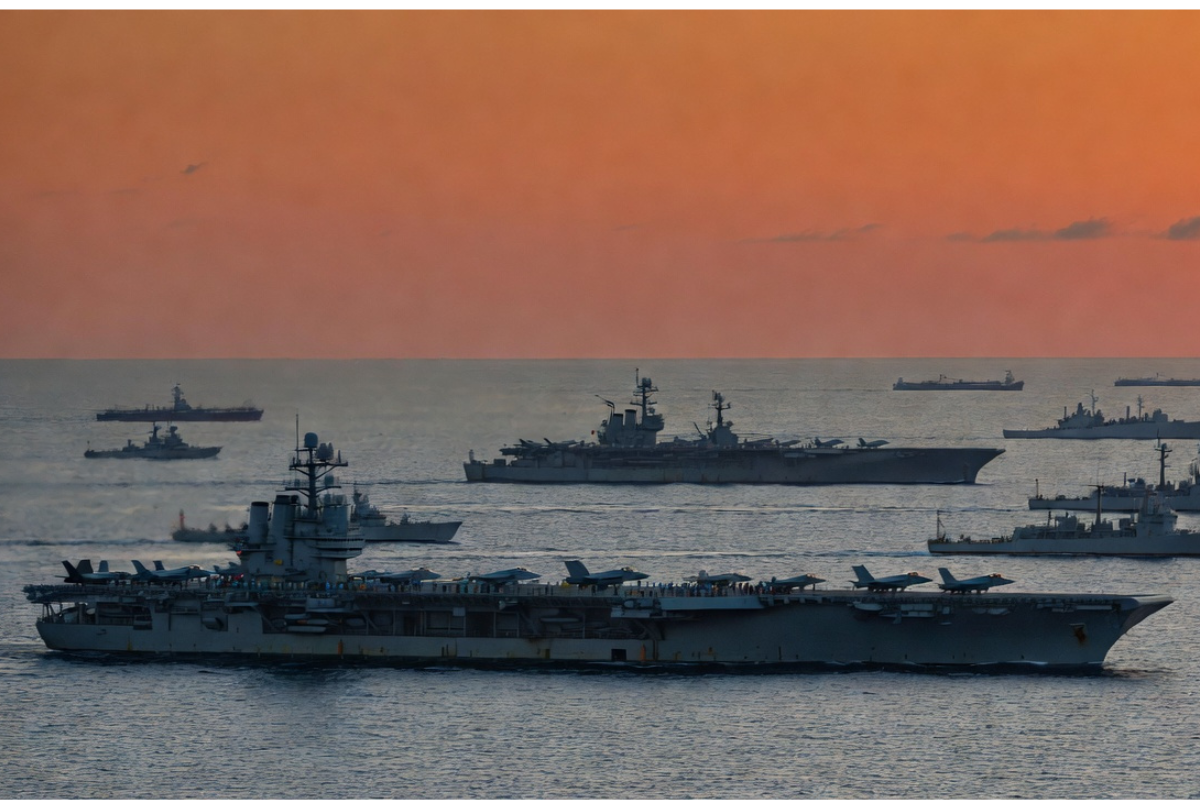
War between the United States and Iran has long been discussed in strategic circles as a dangerous but avoidable scenario. Now, amid heightened tensions and ongoing military exchanges in the region, some analysts are asking a question that once seemed unthinkable. Could the United States actually lose?
One of them is Professor Jiang Xueqin, who recently outlined his argument on the political programme 'Breaking Points'. Jiang contends that if the conflict turns into a prolonged war of attrition, Iran could exploit structural vulnerabilities in the American military and the Gulf region.
His view remains controversial. Many defence experts argue that the United States retains overwhelming military superiority. Still, Jiang's case rests on several concrete strategic concerns rather than headline-grabbing rhetoric.
Jiang argues that Iran has spent decades preparing for asymmetric warfare against a technologically superior adversary. Iran's strategy, he says, is not built around matching the United States weapon-for-weapon. Instead, it relies on endurance, decentralised operations and cost asymmetry.
Iran has long supported regional proxy groups, including Hezbollah in Lebanon and the Houthis in Yemen. These groups have developed experience using drones, rockets and missile systems to pressure stronger opponents. Western intelligence agencies have documented Iranian material support for such organisations, although the degree of direct operational control remains debated.
Military analysts widely acknowledge thatlow-cost drones can create serious challenges for advanced air defence systems. Interceptor missiles such as the Patriot system can cost several million dollars per unit, while some Iranian-designed drones are estimated to cost tens of thousands. Over a prolonged conflict, this imbalance could strain stockpiles and defence budgets.
That said, the United States maintains vastly superior logistics, global alliances and industrial capacity. Whether cost asymmetry alone could determine the outcome of a war remains uncertain.
A central pillar of Jiang's argument concerns the Gulf region's vulnerability. The Strait of Hormuz is one of the most critical energy chokepoints in the world. Historically, roughly one-fifth to one-quarter of the global oil trade has passed through it. Any sustained disruption would likely send shockwaves through global markets.
Iran has previously threatened to close the Strait during periods of confrontation, though it has never successfully maintained a full blockade. Such an action would almost certainly trigger a multinational naval response.
Jiang also highlights infrastructure risks in Gulf states that are members of the Gulf Cooperation Council. Countries such as Saudi Arabia and the United Arab Emirates rely heavily on desalination for potable water. In some cases, desalination accounts for more than half of the domestic water supply. Experts agree that these facilities are strategically sensitive, though they are also heavily protected.
Source: International Business Times UK
