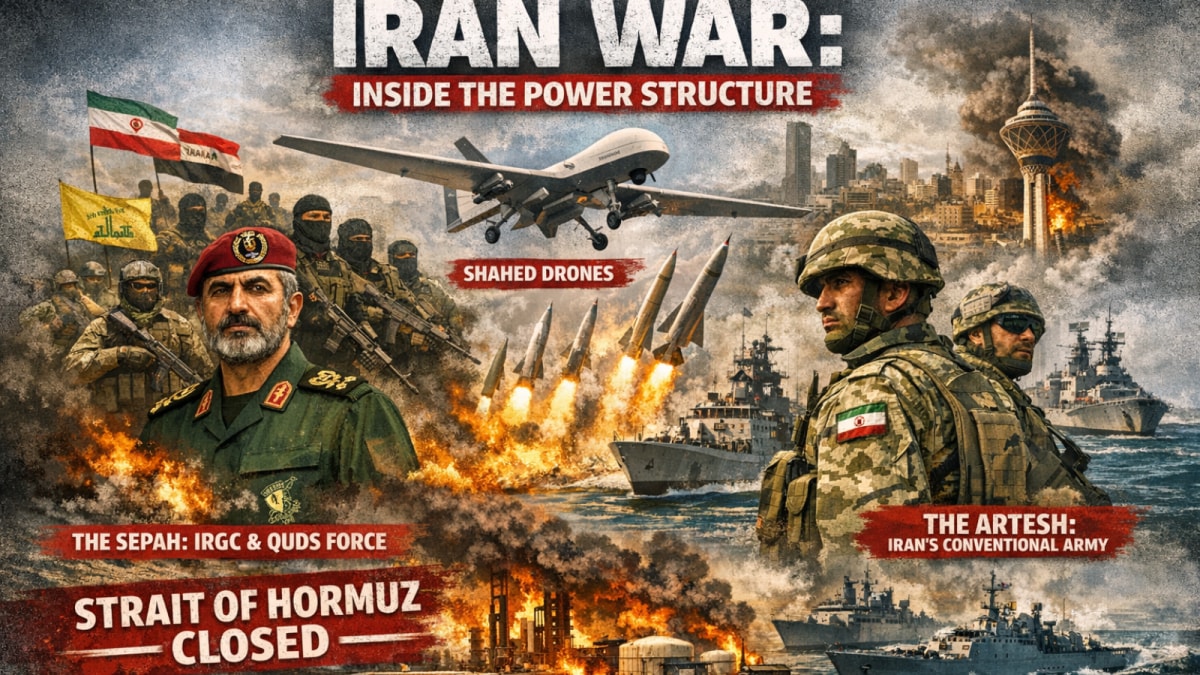
As the Iran war enters its sixth day with no sign of de-escalation- Iranian warships sunk, the Strait of Hormuz closed, global oil markets rattled and a leadership vacuum in Tehran- CNN-News18 has accessed an exclusive intelligence note that lays out in stark detail the true nature of Iran’s military capabilities. What emerges is a picture of a force that is ideologically hardened, structurally layered, regionally entrenched and far from broken.
The Tip Of The Spear: The Sepah
At the apex of Iran’s war-fighting architecture sits the Sepah- the Islamic Revolutionary Guard Corps or IRGC. The IRGC has offensive capabilities that span both its external arm, which steers Iran’s many proxies in the region, and a domestic one that keeps close oversight over the activities of dissidents and anti-establishment entities within Iran. Feeding into that domestic role is the Basij- a vigilant student and social pressure group that cracks down on any local opposition even before it brews.
The Quds Force: Iran’s Regional Operator
The IRGC’s most consequential external instrument has been its Quds Force- the operational arm that in its prime prosecuted Iran’s biggest regional operations against its many adversaries. Its most celebrated- and now severely damaged- project was Hezbollah in Lebanon. Israel unravelled that project last year.
In Iraq, Iran’s influence through the Hashd al-Shaabi- the Popular Mobilisation Forces- remains potent and largely intact, getting the legitimate Iraqi government to fall in line with Iran. Iran similarly propped up the Fatemiyoun Brigade, drawn from Afghan Shia fighters and the Zainabiyoun Brigade, composed of Pakistani Shias. Both formations were deployed in the Syrian civil war when Assad was in power.
The Artesh: Iran’s Conventional Army
The division of labour between the two is geographically telling: the Artesh Navy is responsible for operations east of the Strait of Hormuz, while the IRGC Navy controls the waters inside the Persian Gulf to the west. It is the IRGC Navy that has now enforced the closure of the Strait of Hormuz, triggering a 10–13% surge in global crude prices since the war began on February 28.
The Drone Arsenal: Iran’s Most Asymmetric Weapon
The most potent munitions- in the form of combat drones and UAVs- remain with the IRGC. Iran is assessed to possess an arsenal of between 1,00,000 and 1,50,000 Shahed drones, which wreaked havoc in Ukraine. Despite Russian prowess in rocket technology, Moscow has depended on Iran to supply it with these swarming drones, which have overwhelmed all possible missile defence in Ukrainian airspace through the doctrine of airspace saturation.
Source: World News in news18.com, World Latest News, World News
