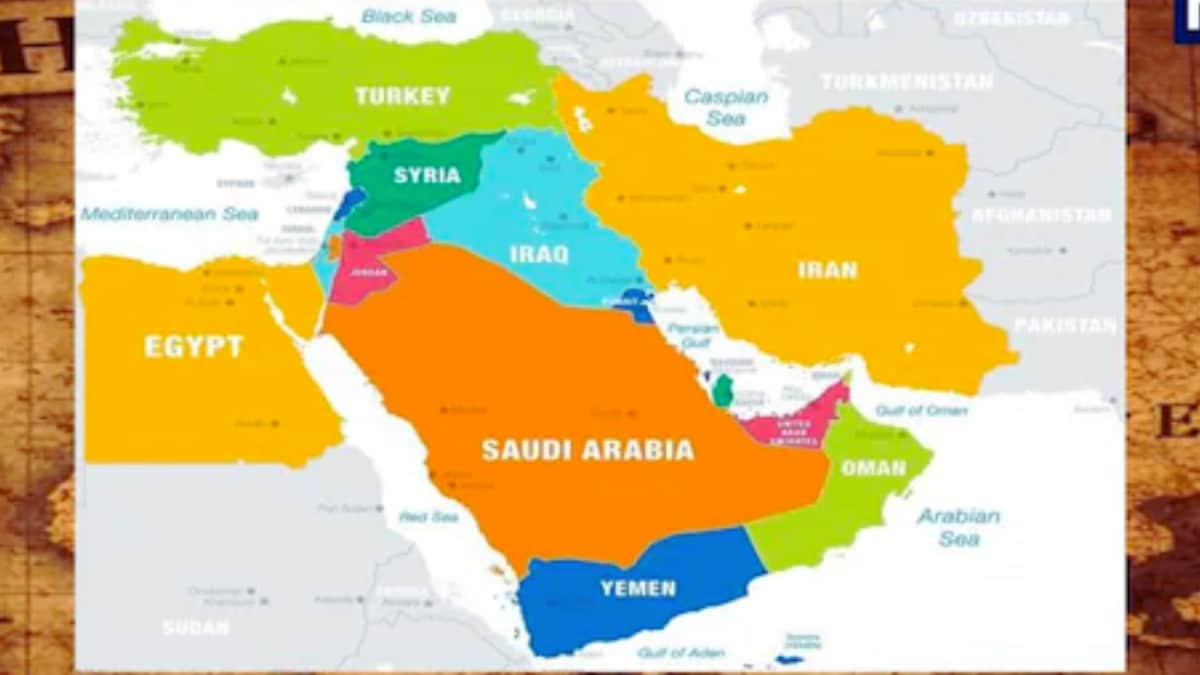
At present, headlines around the world are dominated bythe US-Israel and Iran war. In the midst of such coverage, one term appears repeatedly – ‘Middle East’. It is used in news reports, academic texts and diplomatic discussions almost every day.
Yet few pause to consider what the phrase truly means. Whose ‘middle’ is being referred to? And east of where? Although the term sounds neutral and geographical, its origins are deeply rooted in the colonial era, when the British Empire shaped global narratives and maps according to its own strategic interests.
The term ‘Middle East’ was first used in 1902 by American naval strategist Alfred Thayer Mahan. Writing about British geopolitical interests, he described the region between India and the Persian Gulf, the latter being the historical name associated with Iran, as the ‘Middle East’.
Crucially, his viewpoint was centred on Europe. At the time, the world was commonly divided into three broad zones: the ‘Near East’ (referring largely to the Balkans and territories of the Ottoman Empire), the ‘Middle East’ (the area between India and the Persian Gulf), and the ‘Far East’ (including countries such as China and Japan).
Each of these labels was based on distance from London, effectively placing Europe at the centre of the world map.
As the British Empire expanded across continents, it required convenient terminology to classify its vast territories. Regions such as Egypt were grouped under the ‘Middle East’ because they lay east of London, though not as distant as the ‘Far East’ of Asia.
Meanwhile, British India was sometimes described as part of the ‘Far East’ due to its considerable distance from Europe.
These designations were far from neutral. They were shaped by imperial trade routes, naval power and strategic interests rather than by cultural or geographical realities.
Following the First World War and the collapse of the Ottoman Empire, several new nations emerged across West Asia. During this transitional period, British and American officials began using ‘Middle East’ more widely in diplomatic and military contexts.
The phrase gradually became a convenient umbrella term for policy-making and strategic planning. However, its boundaries were never clearly defined. Even today, there is ongoing debate about whether countries such as Iran, Turkey or parts of North Africa should be included within the ‘Middle East’.
Source: World News in news18.com, World Latest News, World News
