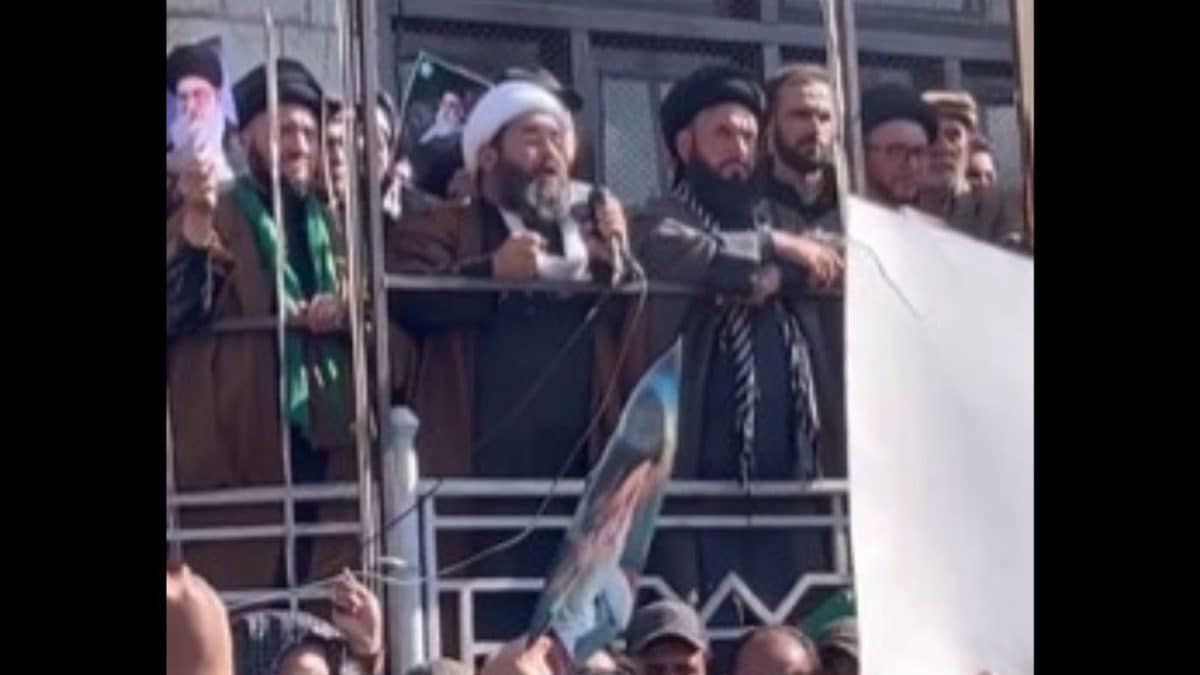
A prominent Shia religious leader, Shaikh Karamat Hussain Najafi, has issued a public warning to Pakistan’s Prime Minister Shehbaz Sharif and his ruling Pakistan Muslim League (N) (PML-N), demanding withdrawal from the recently formed Gaza Peace Board, which he claimed is influenced by Zionist interests. The ultimatum comes ahead of upcoming elections in Gilgit-Baltistan and across Pakistan.
Speaking to a large gathering in Gilgit-Baltistan, Shaikh Najafi said, “I will not use this gathering for politics, but I will say one thing: anyone who recites the creed of Ali-un-Wali-ullah, let my words reach every corner of the country, let the whole of Pakistan listen."
He emphasised that his warning was directed at the government and its allied parties, and repeated the demand, stating, “Before the elections in Gilgit-Baltistan and in Pakistan, if you do not withdraw from the Peace Board, which has been formed under the leadership of Jews and Zionism, then you will be humiliated and disgraced in every street of Pakistan, and especially across Gilgit-Baltistan."
The cleric also appealed directly to the people of Gilgit-Baltistan, asking, “Will you sacrifice your blood in obedience and support of your leader?" He further declared a pledge, saying that those aligned with the government would face public humiliation if the Peace Board issue was not resolved: “Raising both hands in a renewal of the pledge with the martyr and the coming leader, this is our promise. The Muslim League (N) and all its supporting parties will be disgraced and humiliated. This is our final message."
Shaikh Najafi’s statements come at a time of heightened political sensitivity, with Gilgit-Baltistan preparing for elections, and national polls looming. Analysts say the cleric’s ultimatum underscores the influence of religious leaders in Pakistan’s regional politics, particularly in Gilgit-Baltistan, where religious identity and political loyalties often intersect.
An initiative by the United States to ensure stabilisation in the post-war region, the board’s core objective is to support stabilisation, reconstruction, and civilian governance while preventing a power vacuum.
The body is envisioned as a temporary arrangement involving international stakeholders, regional actors, and Palestinian technocrats to oversee aid delivery, rebuilding of infrastructure, and basic administration. It is not meant to replace Palestinian political aspirations but to create conditions for long-term peace, security, and economic recovery in Gaza during a sensitive post-conflict phase.
Pakistan’s agreement to participate in the initiative has sparked strong domestic criticism, highlighting deep political, religious, and ideological divisions across the country. Opposition parties, religious organisations, and scholars have raised serious questions about both the government’s motivations and the decision-making process, placing the Shehbaz Sharif administration under pressure as it seeks to control the national discourse.
Imran Khan’s Pakistan Tehreek-e-Insaf (PTI) has emerged as one of the most vocal critics, arguing that a move of such geopolitical and moral consequence cannot ignore the will of Pakistan’s nearly 250 million people.
Source: World News in news18.com, World Latest News, World News
