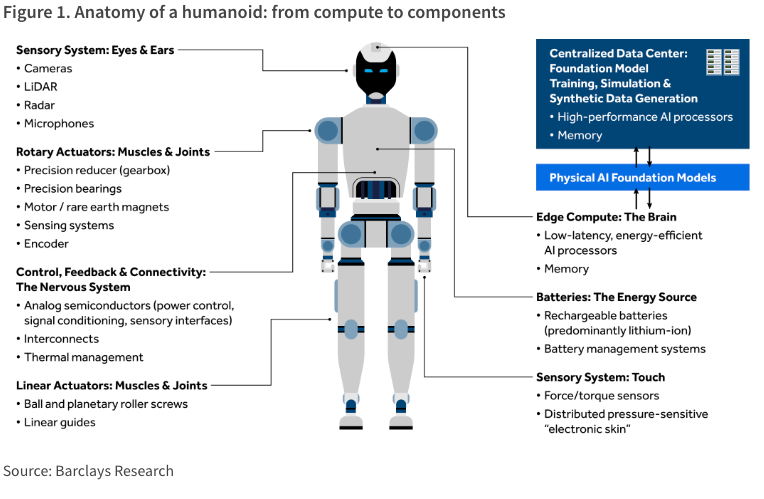
Building on our "Physical AI Faces One Critical Chokepoint, and Here's How to Profit" report earlier this week, Barclays analysts are closing out the week with a comprehensive map of the humanoid value chain.
As readers look beyond flashy Chinese Unitree robot demonstrations, attention is shifting toward the critical hardware stack, including motors, actuators, sensors, and batteries, and the deep supply-chain players positioned to reap the rewards before global humanoid deliveries begin to ramp up.
Anatomy of a humanoid robot
"While the humanoid market remains small today, at roughly $2-3bn, forecasts range from $10-25bn by 2030, with more optimistic scenarios reaching ~$200bn by 2035, as detailed in (open in new tab)Global Macro - AI gets physical: Ten things to know about humanoids(open in new tab)," Barclays analyst William Thompson wrote in a note on Thursday.
Within the hardware stack, reducers - high-precision gearing systems embedded in actuators - have been high barriers to entry and are led by Japanese players such as Harmonic Drive Systems and Nabtesco, while rare earth materials - particularly magnets used in high-performance motors - create strategic dependencies, with supply chains heavily concentrated in China.
Actuators are the biggest hardware prize. A humanoid may require 40 to 70 actuators, representing roughly 30% to 50% of the material bill. This makes motors, reducers, bearings, and motion-control systems critically important.
The current supply chain for humanoids is mostly dominated by