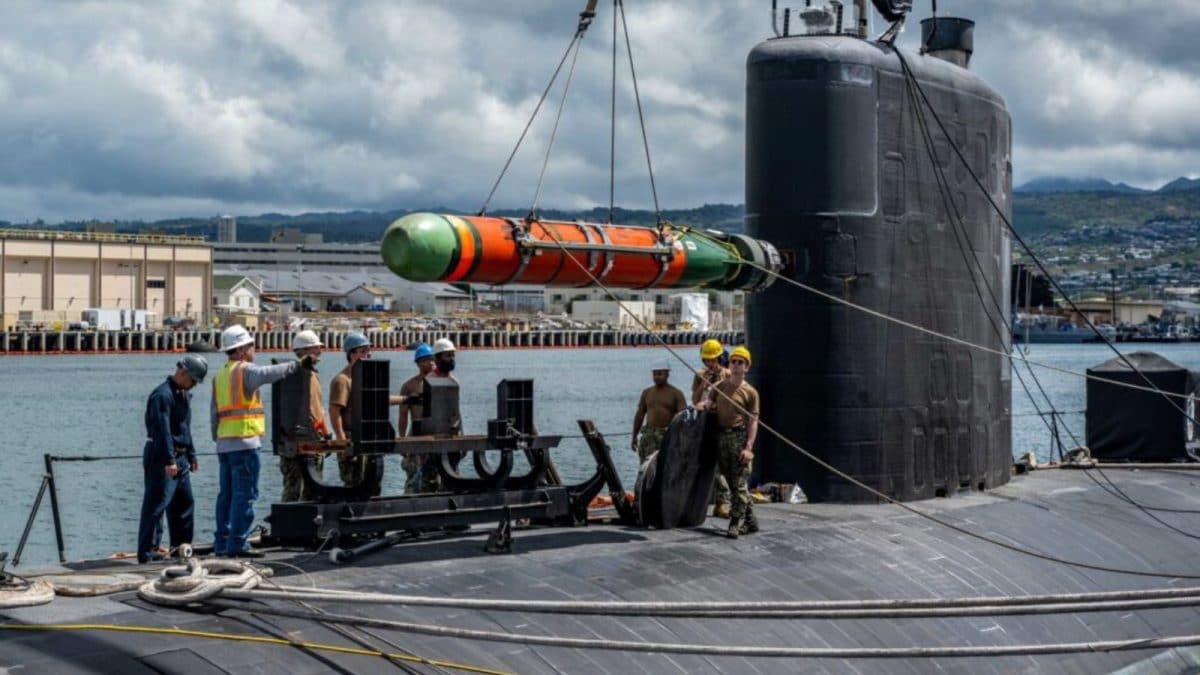
A US Los Angeles-class fast-attack submarine sank an Iranian warship in the Indian Ocean this week, marking the first time an American submarine has destroyed an enemy vessel since World War II. The attack, carried out with a Mark 48 torpedo, was touted by US Defence Secretary Pete Hegseth as evidence of America’s global reach in the Israel-US-IraIsrael-US-Iran warwar.
“An American submarine sunk an Iranian warship that thought it was safe in international waters. Instead, it was sunk by a torpedo," Hegseth told a news conference.
The Mark 48 is a state-of-the-art heavyweight torpedo with a 650-pound warhead, capable of tracking and engaging surface ships and submarines with extreme precision. It measures about 19 feet in length, 21 inches in diameter and weighs around 3,700 pounds. Unlike the unguided torpedoes of World War II, it can home in on targets using active or passive sonar, operate with or without wire guidance, and reengage if it misses, making it “barely even the same species" as its historical counterparts, according to James Holmes, the JC Wylie Chair of Maritime Strategy at the US Naval War College. “The Mark 48 is optimal for engaging enemy submarines, giving it a whole new operating dimension," Holmes said.
ALSO READ |‘They Took Out The Eyes!’: How Iranian Attack On 5,000 Km Range Ballistic Radar Has ‘Blinded’ US
According to Sri Lanka Guardian, unlike most anti-ship missiles that strike a vessel above the waterline, the Mark 48 torpedo is designed to explode beneath the ship’s hull, targeting one of the most vulnerable points in naval design.
When the warhead detonates under a vessel, it generates a massive gas bubble that rapidly expands and then collapses. The initial surge can lift thousands of tons of steel out of the water, while the collapse removes the support that keeps the hull afloat, causing it to bend, crack, or even break in two. Even if the ship’s structure remains intact, critical systems, like propulsion shafts, bulkheads, and electronics, are often destroyed, leaving the vessel crippled or completely inoperable.
Retired Navy Captain Thomas Shugart, a former submariner, described the strike as overwhelmingly effective. “This ship didn’t have a chance… it probably had no idea the submarine was there. It had no way to see the weapon coming. It’s probably the most assured way to sink a ship like that, but also the most punishing," he told Task & Purpose, an American digital news and media organisation that covers the US military, veterans, and the defence industry.
General Dan Caine, chairman of the Joint Chiefs of Staff, confirmed that the Mark 48 torpedo was used to neutralise the Iranian frigate IRIS Dena, one of more than 20 vessels destroyed as part of the US-Israeli military campaign against Iran. The strike also demonstrated the US Navy’s ability to operate far from home waters against a modern warship equipped with long-range missiles, without risking aircraft or surface vessels—an attack that Hegseth called the “quiet death".
The Mark 48 torpedo, costing roughly $4.2 million per unit, is designed to deliver devastating effect against heavily armed ships. Experts say its use in this strike highlights a significant return of submarines to offensive operations after decades of primarily surveillance and deterrence roles. Retired Navy Captain Bent Sadler, speaking to Task & Purpose, noted: “The strongest use of submarines is unleashing the captains of those boats with a set of orders: Go in this area and kill anything that meets the following conditions, and act as you see fit."
ALSO READ |A War Too Close To Home: Why US Sinking Iranian Frigate IRIS Dena Matters To India
Source: World News in news18.com, World Latest News, World News
