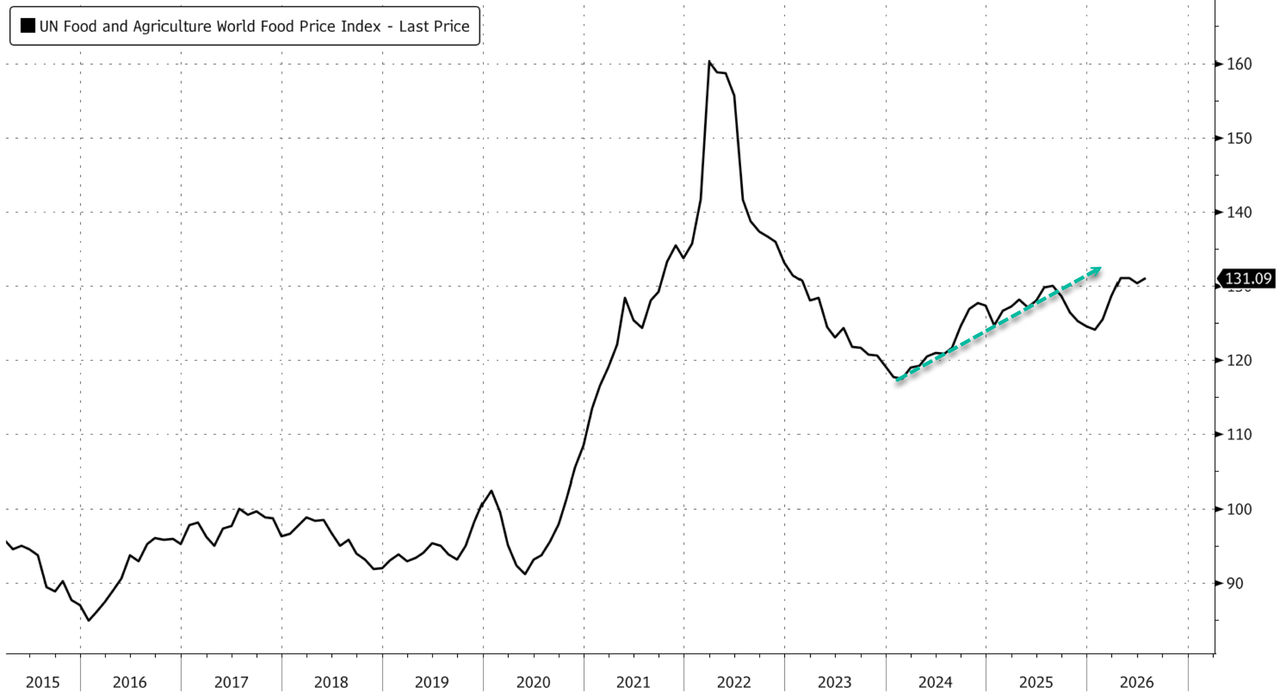
The UN Food and Agriculture Organization’s Food Price Index climbed to a three-year high in July, extending its upward trajectory as conflicts across Eurasia (the Black Sea and the Hormuz chokepoint) disrupt critical trade routes and mounting El Niño risks threaten global harvests.
The United Nations Food and Agriculture Organization’s FAO Food Price Index, which tracks monthly changes in the international prices of a basket of globally traded food commodities, averaged 131.09 last month, up .6% from the previous month, led by gains in grain, sugar, and vegetable oils.
Wheat surged 5.8% during the month to a two-year high, while corn climbed 3.6%. Vegetable oil prices reached their highest since June 2022, while meat and dairy prices declined, according to the FAO.
Fueling the price surge is the widening Russia-Ukraine war in the Black Sea, where attacks are increasing and threaten critical bulk-shipping corridors. Disruptions through the Strait of Hormuz are also pushing food prices higher by raising energy, fertilizer, and transportation costs. Layered on top of all this are deteriorating crop conditions in major growing regions across the world as El Niño risks mount, a threat that has been flagged for many months.
"Chances of a very strong El Niño are rising. Risks are concentrated in select EMs, with inflationary and fiscal pressures likely to outweigh growth risks. We view El Niño as a key sovereign credit risk, particularly for countries with weak fiscal buffers," Morgan Stanley analyst Emma Cerda wrote in a recent note.
Earlier this week, UBS analyst Sreedhar Mahamkali identified five long-term forces likely to keep global