Authored by Michael Lebowitz via RealInvestmentAdvice.com,
The recent rotation from growth to value is well documented. While the return divergences between, for instance, technology stocks and materials or industrials stocks are significant, they do not tell the whole story. There are also extreme return differentials between broad industries and their sub-industries.
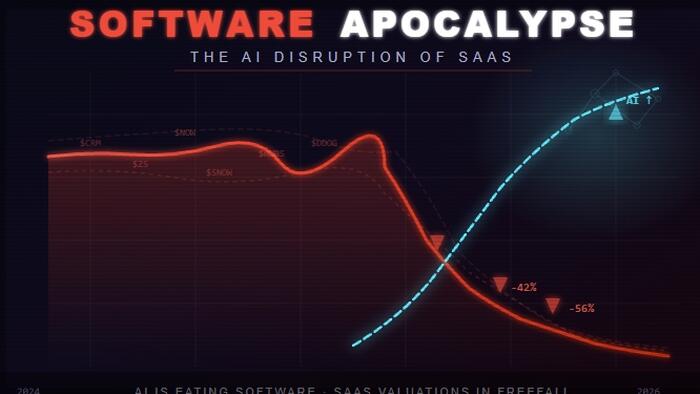
In this article, we address one such divergence between the broad technology sector and the software-as-a-service (SaaS) sub-industry. The graph below shows the wide gap in returns between software, technology, the Nasdaq 100, and semiconductor stocks. Since the well-followed software ETF (IGV) peaked on September 19, 2025, it has fallen 30%. For context, the broad technology indexes (XLK and QQQ) are flat over the period, and the semiconductor ETF (SMH) is up 30%.
Behind every good stock or index move is a narrative. The narrative is the market’s collective explanation for why prices move.Most narratives have some truth, some degree of speculation, and include some falsehoods.The job of an individual or professional investor is to understand the narratives driving money flows, assess their accuracy, and trade accordingly.
As if evaluating the validity of narratives weren’t hard enough, we must also consider that many narratives are, to some degree, based on expectations, in which no one knows what the future holds with certainty.
The bearish software narrative, known as “SaaSpocalypse,” which is the market rationale for big drawdowns in many software stocks, has some truths, lots of speculation, and falsehoods.Let’s explore the narrative, some counterpoints, and assess whether software stocks are a steal or, as some claim, on their way to zero.
The “SaaSpocalypse” story holds that the current AI wave poses a significant threat to traditional software companies because AI changes how software is built, delivered, and priced.
If generative AI can write code, automate workflows, and rapidly and cheaply create customized applications, the value of today’s established off-the-shelf software products declines, and in some cases, may approach zero. Instead of paying for software and recurring subscription fees, enterprises and individuals may soon be able to build their own software easily and cheaply.
As if that weren’t enough of a threat to traditional software companies, AI lowers barriers to entry, enabling more competitors to quickly replicate existing software. More competition should compress profit margins and weaken the “moats” that once protected large software firms.
The primary rebuttal to SaaSpocalypse is that the value of software lies beyond the code. Enterprise SaaS companies derive their lasting power from durable moats such as network effects, high switching costs, proprietary data, compliance infrastructure, and trust. AI-created software or a competing software product from an AI-driven startup might replicate the look and feel of a software program, but it cannot recreate years of customer data, deep integration with other core systems, and, importantly, the confidence required for corporate deployments.Essentially, the rebuttal argues that the narrative fails to distinguish between the look and feel of software and the other attributes that can make it valuable.
Source: ZeroHedge News