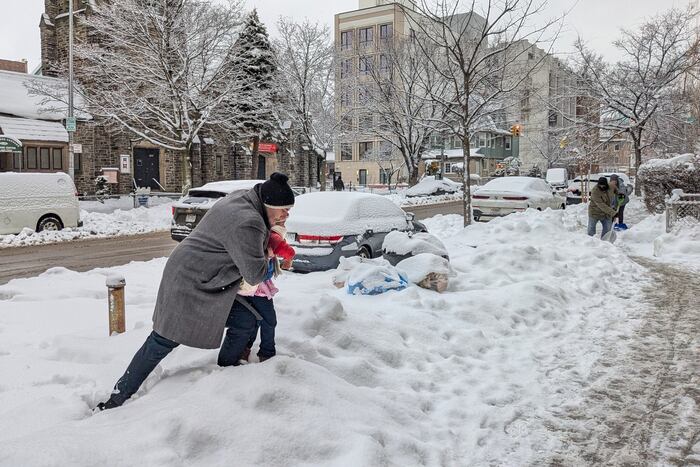
NEW YORK (AP) — Light snow fell over parts of the Northeast on Wednesday as people navigated to work and school after a massive storm that dropped piles of powder on streets and sidewalks from Maryland to Maine.
One to 3 more inches (2.5 to 7.6 centimeters) of snow was expected, much less than the last storm, but whatever melted likely froze again overnight, resulting in patchy black ice to make for some slippery roads, the National Weather Service said. As temperatures rose by mid-morning in some places, much of that became a slushy mess.
The gigantic snowstorm this week has cities working overtime to clear towering heaps. In New York City, Mayor Zohran Mamdani got creative: in addition to spreading 143 million pounds (65 million kilograms) of salt by Tuesday evening, the city signed up at least 3,500 people as emergency shovelers, working $30-per-hour shifts to clear snow from bus stops and streets.
Power had returned for many of the hundreds of thousands who had lost electricity in Massachusetts, New Jersey, Delaware and Rhode Island. But nearly 160,000 customers in Massachusetts were still without power early Wednesday. Cape Cod, which accounted for most of the outages in the state, slowly began to see power return Wednesday, with utility Eversource promising that “99% of customers” would have electricity restored by Friday.
In Newport, Rhode Island, first responders found 21-year-old Salve Regina University student Joseph Boutros unresponsive as he charged his phone inside a car parked outside a university building. Police said the vehicle’s exhaust pipe was obstructed by snow and said his death from carbon monoxide poisoning was accidental.
Many Rhode Island residents faced a third straight third morning stuck in their homes as residential streets remain unplowed. Those who did get out often had to trek by foot to the nearest major roadway.
Some sidewalks are impassable for people with disabilities
There was plenty more work left to do. Parts of New York have people feeling like they're marooned on islands, according to Jeff Peters, spokesperson for the Center for Independence of the Disabled, New York.
“You’ll find a portion of a sidewalk that is clear, and then there’s maybe a 6-inch (15-centimeter) pathway that can only be walked with one foot in front of the other and no room for a stroller, rollator, walker or crutches,” Peters said. “Then you get to the corner and not only is it unshoveled, but you have basically a glacier at the end of it.”
Tina Guenette, who uses a motorized wheelchair, had to shovel out her yard this week after more than 33 inches (84 centimeters) fell in Harrisville, Rhode Island, a town about 17 miles (27 kilometers) northwest of Providence.
Source: WPLG