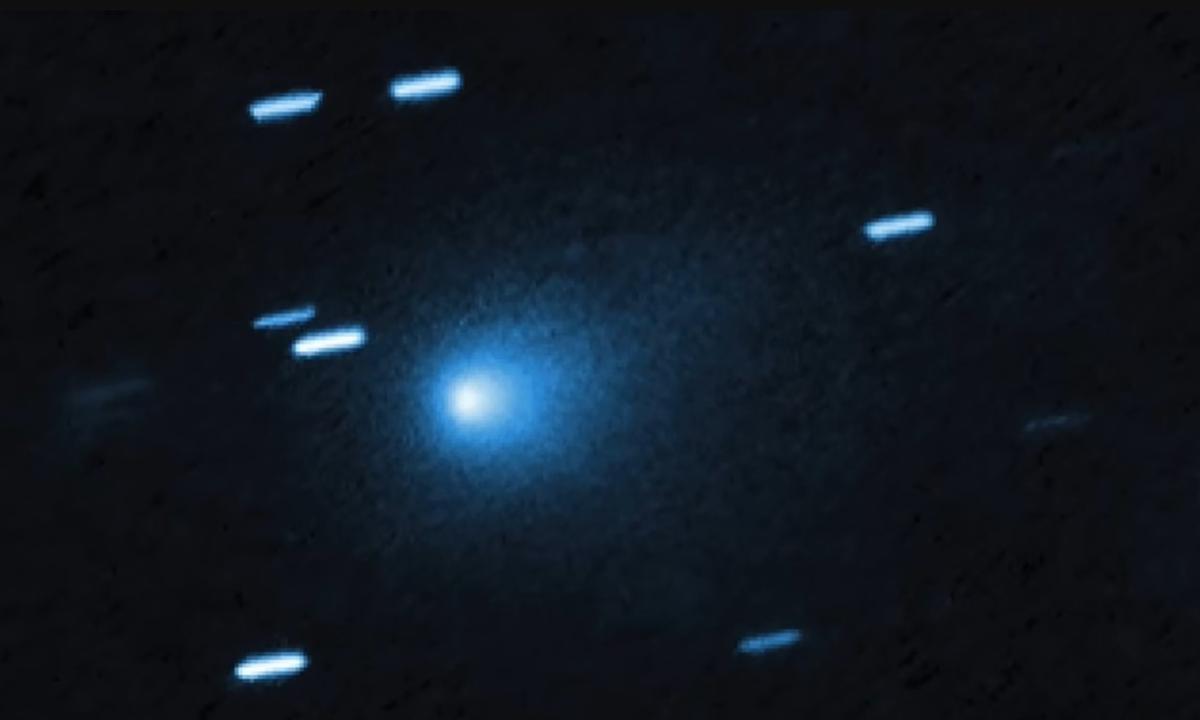
A mysterious visitor from the depths of interstellar space has just challenged our understanding of the cosmos. It's not merely a frozen chunk of ice drifting through the void but potentially a vessel carrying the fundamental ingredients for life itself.
A prominent Harvard scientist now suggests this celestial object could be an active participant in seeding the universe, acting as a cosmic vessel for biological material.
The scientific community was captivated by the NASA spacecraft's discovery of a suite of complex chemicals aboard the comet known as 3I/ATLAS. Observations conducted in December revealed the presence of organic molecules, specifically methanol, cyanide, and methane—compounds most astronomers view as essential ingredients for life on Earth.
The findings come courtesy of NASA's SPHEREx spacecraft, an observatory that scans the cosmos in near-infrared light to reveal details that would normally stay invisible in the deep darkness of space. Observers noted that the comet became spectacularly bright during the two months following its tour of the sun, with luminosity increasing as solar energy forces these interstellar snowballs to sublimate water, carbon dioxide, and carbon monoxide previously trapped in ice.
Carey Lisse, the study lead from the Johns Hopkins Applied Physics Laboratory in Laurel, Maryland, provided context on the materials released. 'We are now seeing the usual range of early Solar System materials, including organic molecules, soot, and rock dust, that are typically emitted by a comet,' Lisse explained. Phil Korngut, a SPHEREx scientist at Caltech in Pasadena, California, asserted that the sun's energy potentially released a 'cocktail of chemicals that haven't been exposed to space for billions of years'.
Whilst the presence of frozen gases is expected, the specific behaviour of methane on 3I/ATLAS has puzzled experts. Avi Loeb, a Harvard scientist known for his provocative theories on extraterrestrial life, pointed out a significant irregularity. Methane has a very low sublimation temperature, meaning it should theoretically evaporate long before other gases like carbon dioxide. However, recent findings suggest the methane survived much longer than physics would typically predict.
'That's a puzzle because first of all, methane can evaporate more easily than carbon dioxide, which was observed from the beginning,' Loeb told the Post. This discrepancy led him to speculate that the gas was either buried incredibly deep or, more radically, 'produced by lifeforms'. In a recent Medium blog post, he wrote: 'Maybe it's not as simple as just ice being evaporated by illumination of sunlight. The methane is being produced by something that is thriving, especially when it's illuminated by sunlight, like life that came to life suddenly.'
The implications of these biological precursors have led to a fascinating theory regarding the comet's true purpose. Loeb believes 3I/ATLAS might function as an 'interstellar ark' or a probe sent by an advanced civilisation to populate the stars. He questioned the Post directly: 'Is it possible that there are microbes or some forms of life on 3I/ATLAS?' His conclusion was stark—'If such a rock had microbes in it, they would've survived.'
This aligns with the concept of an 'interstellar gardener with ambitions to spread life technologically', suggesting the comet is not wandering aimlessly but rather fulfilling a specific biological directive. The idea redefines the object from a passive rock to an active carrier of biological potential.
🚨 NASA has found ingredients for life on an interstellar comet.☄️🛸⚠️SPHEREx observations reveal that interstellar comet 3I/ATLAS is releasing methanol, methane, cyanide & CO₂ — organic molecules essential to life as we know it.😳🔭 Detected after the comet’s close solar…pic.twitter.com/mMLiTKwQkp
Source: International Business Times UK
