The rise of physical AI is already underway, with humanoid robots entering factories, warehouses, and other industrial environments, and soon the modern battlefield.
Global shipments of humanoid robots are expected to accelerate in 2027, but the broader robotics revolution faces one critical chokepoint: access to the rare-earth magnets that power high-performance motors and actuators. China controls most of that supply chain.
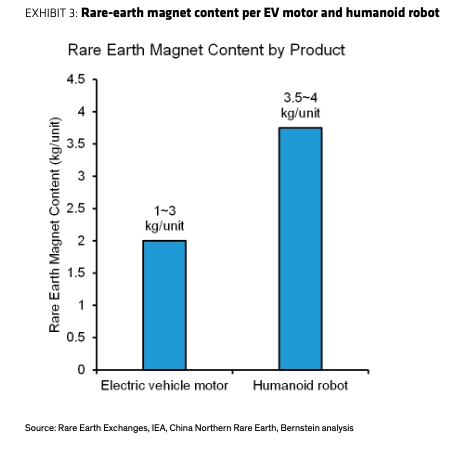
Bernstein analyst Dien Wang told clients Monday that humanoid robots require an estimated 3.5 to 4 kilograms of rare-earth magnets per unit, compared with roughly 1 to 3 kilograms for an EV motor.
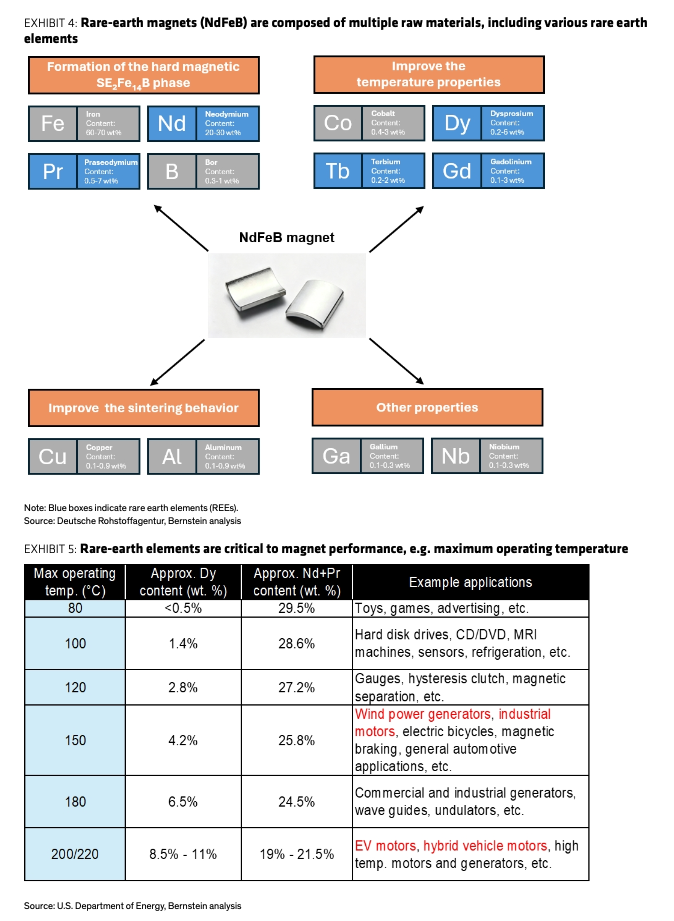
"A humanoid robot can consume more than twice as much magnetic material as an EV motor (Exhibit 3), highlighting the growing strategic importance of rare-earth magnets. Beyond well-known neodymium (Nd) and samarium (Sm), rare-earth elements such as dysprosium (Dy), terbium (Tb), and praseodymium (Pr) are also critical for magnetic performance (Exhibit 4, Exhibit 5). We therefore see the entire rare-earth magnet value chain as strategically important," Wang said.
Rare-earth magnets (NdFeB) are composed of multiple raw materials, including various rare-earth elements.

« Back to The Culture War