Technology has now deeply embedded itself in daily life. Almost every household appliance has turned hi-tech, many powered byArtificial Intelligence (AI). From washing machines to vacuum cleaners, devices are rapidly becomingroboticand AI-enabled. Consumers are embracing these smart gadgets without fully considering their potential risks. In a startling development, one such device has triggered a major privacy scare, forcing users to rethink their dependence onsmart technology.
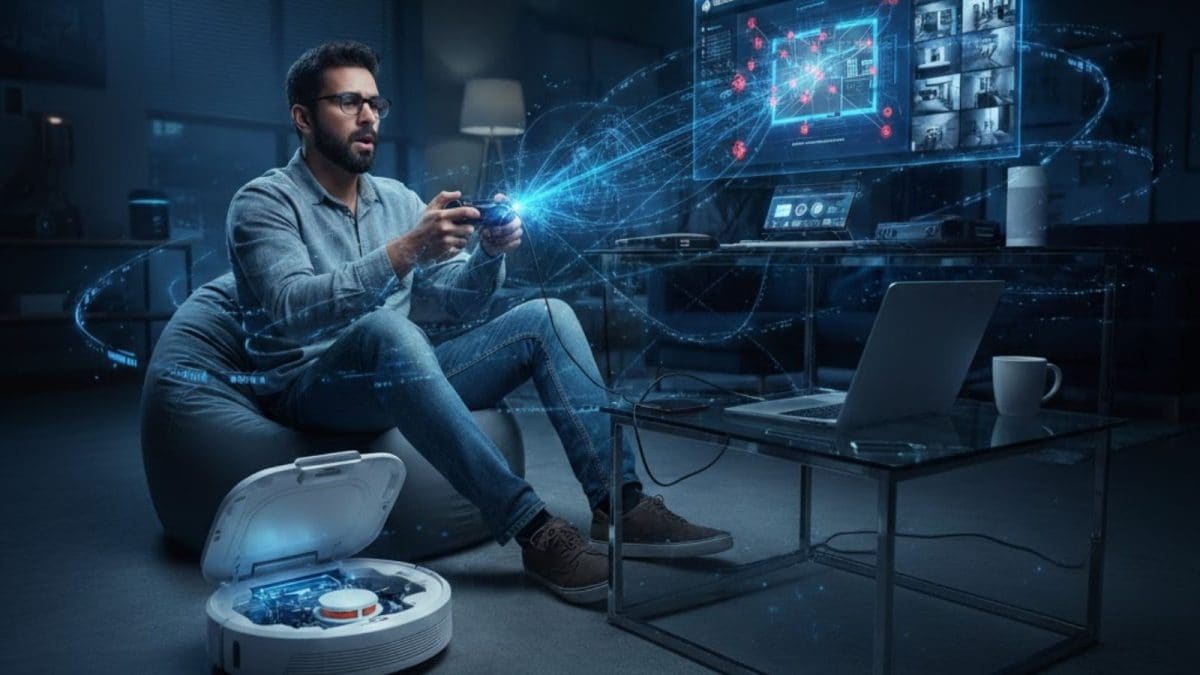
A man attempting to operate hisrobotvacuum cleaner using a gaming controller inadvertently gained access to thousands of homes across the world. There was no cyberattack, no password breach, and no server hack. Yet, a minor technical misconfiguration exposed the privacy of nearly 7,000 households. The incident has raised serious concerns about the security architecture of smart home ecosystems.
According to a CNBC TV18 report, the man, who leads AI strategy at a vacation rental company, was developing an app to remotely control his robot vacuum using an AI coding assistant. The report states that he reverse-engineered how the device communicates with the company’s cloud servers while building a custom control system using a PlayStation game controller.
However, the moment his application connected to the servers, not just his personal device but thousands of robot vacuums worldwide also linked to his system.
Within moments, he was able to access live camera feeds, digital home maps and device-level data. The fact that all this occurred without hacking stunned the tech community and sparked debate over whether smart gadgets could inadvertently turn into “indoor surveillance tools". According to CNBC TV18, the researcher later said he had no intention of hacking devices and only wanted to control his own robot vacuum remotely.
The issue was later acknowledged by DJI after it was publicly reported on social media platform X. Cybersecurity researchers claimed the vulnerability allowed remote access to movements, microphones and cameras of thousands of devices before it was fixed.
I can confirm that@DJIGlobalhas finally fixed the HUGE vulnerability they had on their servers.This vulnerability was discovered by the very skillful@n0tsa, and he reported it to DJI.
It allowed to take remote control (movements, microphone, camera) of over 10 000 robots…pic.twitter.com/j1UunMmNXX
— Gonzague 👨🏼💻 (@gonzague)February 11, 2026
According to CNBC TV18, the AI expert attempted to create a new app to control his DJI robot vacuum with a PlayStation controller. Using AI coding tools, including AI-assisted coding software, he studied the communication protocol between the device and the cloud server.
Source: Tech News in news18.com, Tech Latest News, Tech News
