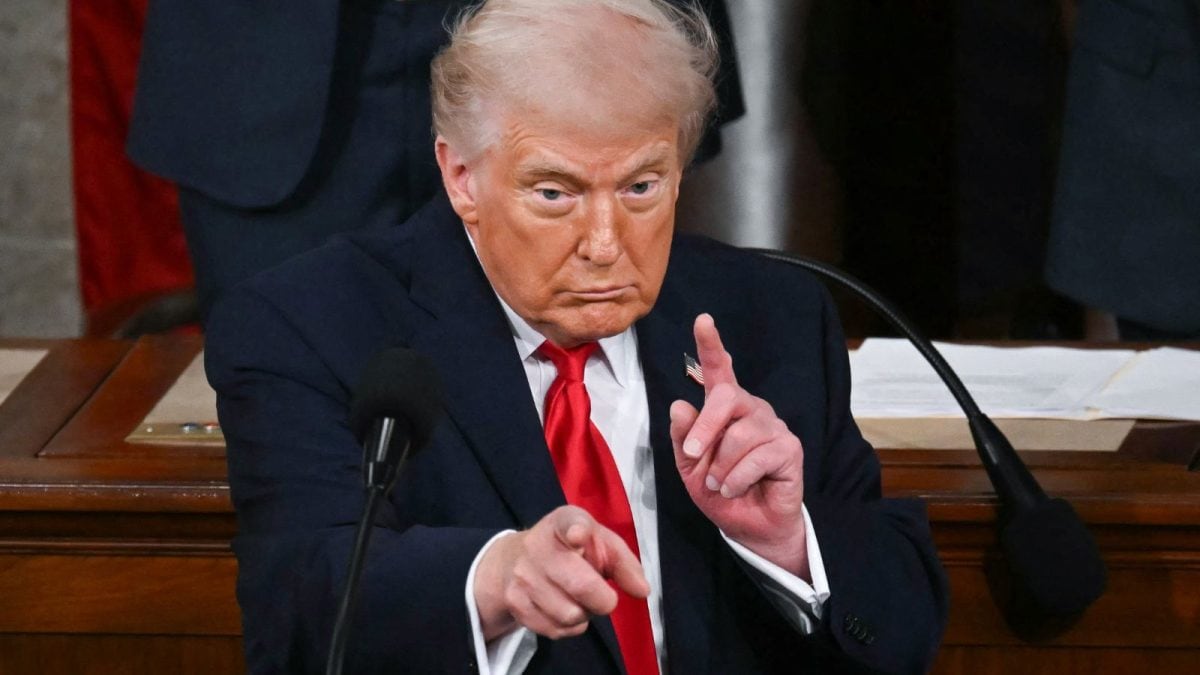
President Donald Trump, delivering his 2026 State of the Union address on Wednesday, framed rising tensions with Iran as one of the central national security challenges facing the United States, asserting that previous US military action had significantly weakened Tehran’s capabilities and warning that any future nuclear ambitions would not be tolerated.
Speaking to a joint session of Congress, Trump cited the 2025 US air campaign against Iranian nuclear facilities—known as Operation Midnight Hammer—as a turning point that “obliterated" Iran’s nuclear programme and prevented the spread of terrorism by the regime. He claimed that without that operation, Iran “would have spread terrorism", framing the strikes as both a defensive and stabilising action.
“Had it not been for Operation Midnight Hammer, Iran’s regime would have spread terrorism. We obliterated their nuclear programme," Trump said. Drawing a red line, the US President said “we can’t let them have a nuclear weapon".
He also claimed Iran is seeking to develop missiles that can strike the United States—long-range weapons technology that only a limited number of countries possess. “They’ve already developed missiles that can threaten Europe and our bases overseas, and they’re working to build missiles that will soon reach the United States of America," Trump said.
“They’ve already developed missiles that can threaten Europe and our bases overseas, and they’re working to build missiles that will soon reach the United States of America," Trump said during his State of the Union address.
In 2025, the US Defense Intelligence Agency said Iran could potentially develop a militarily viable intercontinental ballistic missile by 2035 “should Tehran decide to pursue the capability," but did not say if it had made such a decision.
Tehran currently possesses short- and medium-range ballistic missiles with ranges that top out at about 1,850 miles (3,000 kilometers), according to the US Congressional Research Service.
The continental United States is more than 6,000 miles from Iran’s western tip.
Washington and Tehran have concluded two rounds of talks aimed at reaching a deal on Iran’s nuclear program to replace the agreement that Trump tore up during his first term in office.
The United States has repeatedly called for zero uranium enrichment by Iran but has also sought to address its ballistic missile program and support for armed groups in the region — demands Iran has rejected.
Source: World News in news18.com, World Latest News, World News