Freddie Ponton21st Century Wire
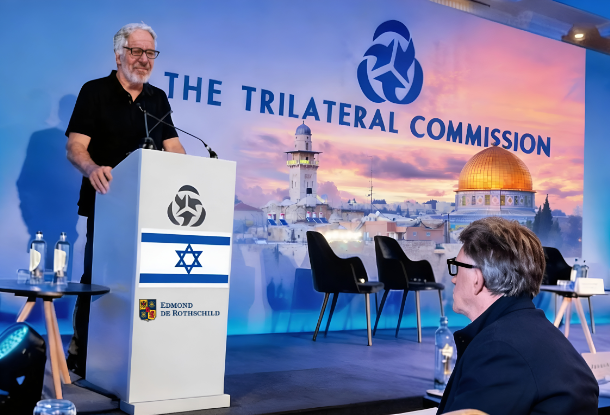
The Department of Justice released 3.5 million pages of documents on the final day of January 2026, and within that avalanche of photocopies and PDFs lay confirmation that investigators had long suspected but could never fully substantiate until now. The records explicitly cite Epstein’s documented ties to the Trilateral Commission, the same US-based invitation-only organisation that currently counts UK Prime Minister Keir Starmer among its active membership. Meanwhile, his former ambassador to the US, Peter Mandelson, a long-standing and prominent member of the Trilateral Commission, was arrested on February 23, 2026, on suspicion of misconduct in public office for allegedly disclosing sensitive government information to the convicted sex offender.
This is not merely a footnote in the saga of a dead predator, nor is it a peripheral detail about elite social networking. It is the key that unlocks the architecture of how power actually operates in the transatlantic system, how policies are crafted far from any ballot box, and how a particular vision of global governance, one articulated publicly by Macron’s mentor (handler)Jacques Attaliwhen he envisioned Jerusalem as the capital of a future unified world government, is being constructed through financial networks that remain deliberately invisible to the populations whose lives they control.
The timeline is analytically crucial and cannot be emphasised strongly enough for those who would dismiss these connections as coincidence or conspiracy. Jeffrey Epstein gained admission to the Trilateral Commission in 1998 through a personal invitation extended by David Rockefeller himself, the organisation’s founder and the architect of its governing philosophy. This recruitment occurred seven full years before the Palm Beach Police Department opened its investigation into Epstein’s sexual exploitation of minors, which means his institutional credibility was granted on entirely different grounds than wealth or philanthropic reputation. It is not clear whether or not the Commission knew anything about his criminality because that criminality had not yet been exposed to law enforcement, but they certainly recognised in the Brooklyn-born college dropout something far more valuable than charitable donations. They saw utility in the form of financial expertise that career politicians lack, access to capital flows that institutions require, and the ability to operate in the shadows between formal governmental structures where deniable influence can be exercised without electoral accountability or journalistic scrutiny.
To understand how this network functions and why it matters for the present political moment, one must look beyond the surface membership lists that the Trilateral Commission publishes for public consumption and examine instead the executive committees and leadership structures where actual decisions are made. The July 2011 Executive Committeedocumentreveals a concentration of Rothschild interests that is impossible to dismiss as incidental or merely reflective of the family’s historical prominence in European finance. General The Lord Guthrie appears as a former director of N M Rothschild and Sons, while Nigel Higgins served as Chief Executive of the Rothschild Group and Alfonso Cortina operated as Vice Chairman of Rothschild Europe.
This is not simply a matter of banker representation in an economic forum. The Rothschild banking dynasty founded the modern state of Israel through the 1917 Balfour Declaration addressed to Lord Walter Rothschild, and provided the crucial financing that transformed Zionist aspirations into geopolitical reality. When Rothschild executives occupy leadership positions in the European Group of the Trilateral Commission while simultaneouslyfinancing an array of child protectionand humanitarian NGOs, including foundations dedicated to helping Ukrainian children (Save the Children) and various safeguarding initiatives, they are not advancing abstract charitable interests. They are operating within a historical continuity where diaspora banking networks function as extensions of state power, where capital flows serve strategic objectives, and where the minimal formal Israeli membership in the organisation masks a far deeper penetration of influence through financial rather than diplomatic channels.
This architecture of influence extends far beyond London and into the continental capitals where European sovereignty is being systematically dismantled. In France, President Emmanuel Macron ascended to power directly from Rothschild and Cie Banque, where he orchestrated the Nestlé-Pfizer merger and advised the French government on economic policy while being groomed for political leadership by the sameAttali Commissionthat envisioned Jerusalem as a world capital. His presidency has overseen the acceleration of French economic integration into EU structures that remove decision-making from national parliaments, while his former banking colleagues continue to profit from the privatisation of public assets. In Germany, Chancellor Friedrich Merz assumed office in May 2025 after serving as Chairman of BlackRock Deutschland from 2016 to 2020, placing the world’s largest asset manager at the centre of the EU’s largest economy. Merz’s tenure at BlackRock saw the systematic accumulation of stakes in German DAX companies, creating silent power through proxy voting rights that now shape industrial policy without democratic visibility.
These are not isolated career trajectories. They represent the convergence of banking intelligence networks with state power, where former investment bankers and asset managers transition seamlessly into political leadership while maintaining loyalties to the financial architectures that built their careers.
The question of why Peter Mandelson maintained his relationship with Epstein after the 2008 conviction, going so far as to write messages assuring the convicted sex offender that his friends loved him and urging him to show the world how big a person he was, cannot be answered only through psychological speculation about personal loyalty or moral failure. The context also lies in Mandelson’s professional position during those exact years when he was offering support to a man who had pleaded guilty to procuring a child for prostitution. During this period, Mandelson served as Chairman of Global Counsel and Senior Advisor at Lazard, the historic banking house whose Lazard Frères arm provided crucial funding for early Israeli infrastructure and which maintains deep connections to the same Zionist networks that the Rothschild family has cultivated for over a century.
This is not a coincidence. It is the interlocking financial-directorship architecture that allows influence to flow through banking relationships, advisory positions, and cross-memberships in elite organisations without ever appearing on the official registers of lobbying or diplomatic representation. When Mandelson wrote those supportive messages to Epstein, he was not merely expressing personal solidarity with a disgraced friend. He was participating in a system of elite mutual protection that prioritises network maintenance over institutional accountability, that shields useful operatives from consequences, and that ultimately advances Israel’s strategic interests through deniable channels.
Source: 21st Century Wire
