A growing number of institutional desks sounded alarms over physical commodity markets this week as maritime chokepoint disruptions intensified across the Gulf.
Goldman Sachs, RBC Capital Markets, JPMorgan, and others warned that a tightening physical market could keep Brent firmly in triple-digit territory and drive prices sharply higher if the disruptions persist.
Joining the conversation was Citigroup Senior Commodities Strategist Eric Lee, who warned Thursday that commodity markets have entered an era of near-constant disruption, with geopolitical, climate, and technological shocks increasingly overwhelming traditional supply-and-demand analysis.
Lee warned:
Commodities markets are in an era where geopolitical, climate and technological shocks routinely overwhelm traditional supply-demand analysis. Rather than only what is most likely, investors need to consider what is plausible, and what markets are least prepared for.
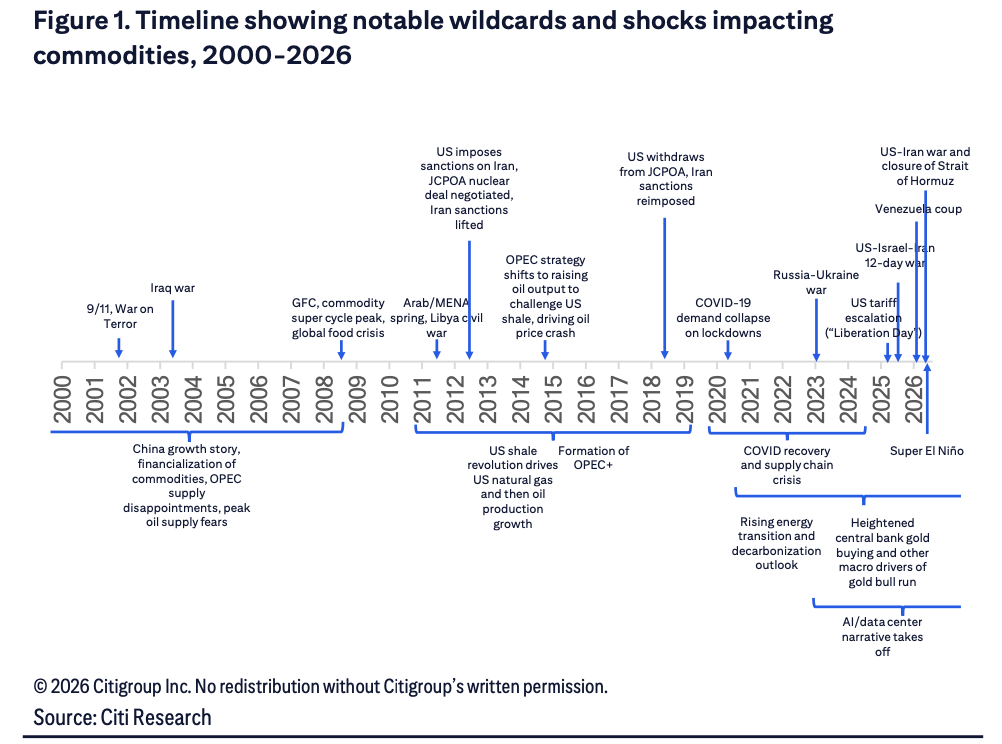
The frequency of major commodities market disruptions appears to be rising. Events once considered "once -a-decade" now seem to emerge every year, or even every six months.
Since the early 2000s, markets have navigated the Global Financial Crisis, the Arab Spring, the US shale revolution, OPEC's strategic policy shifts; since 2020, wildcards include COVID-19, the Russia-Ukraine conflict, trade wars, gold-positive macro concerns, weather-driven agricultural disruptions, and repeated Middle East conflicts.
Timeline showing notable wildcards and shocks impacting commodities, 2000-2026
List of notable wildcards and shocks impacting commodities:
« Back to The Culture War