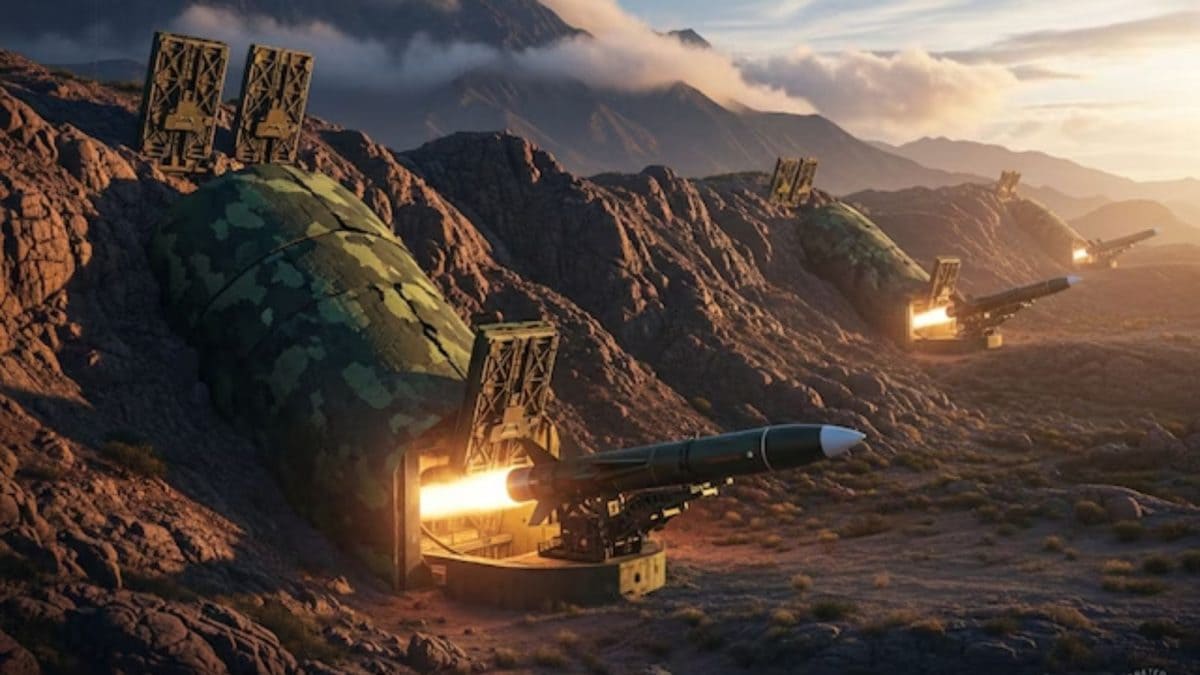
Israel’s concern overIran’s missilecapabilities is rooted in the steady development of a sophisticated programme that combines advancing technology with unconventional launch strategies. WhileIran’s missile arsenalis widely recognised for its range and power, analysts say its underground launch infrastructure is equally significant, allowing Tehran to conceal weapons and carry out rapid, large-scale strikes with limited warning.
Over the past four decades,Iranhas invested heavily inmissiletechnology and underground storage networks, building what military observers often describe as “missile cities", vast tunnel complexes where missiles are stored and prepared for launch. These systems allow Iran to keep key assets hidden deep underground and deploy them quickly during a conflict.
The origins of Iran’s missile programme date back to the 1980-88 Iran-Iraq War, when Iraqi missile attacks on Iranian cities exposed Iran’s limited retaliatory capability. The experience convinced Iranian planners of the need for long-range missiles as well as secure launch systems that could survive enemy strikes. Assistance from countries such as China and North Korea is widely believed to have played a role in the early stages of Iran’s missile development.
During the 1990s, Iran acquired Scud-based technology from North Korea and began developing indigenous missile systems such as the Shahab-3 and Sejjil. Alongside missile production, Tehran expanded its network of underground silos and tunnels designed to protect weapons from aerial surveillance and pre-emptive attacks.
Traditional silo technology involves storing missiles in reinforced underground shafts, where they remain ready for launch. Iran has adopted such systems but has also developed more flexible tunnel-based launch methods. In some underground facilities, missiles are positioned on rail tracks, allowing multiple launch-ready weapons to be moved quickly into firing position. Military analysts sometimes describe this arrangement as resembling a “missile magazine", where successive missiles can be launched in rapid sequence.
These facilities are typically concealed beneath layers of soil and reinforced concrete. Small surface openings or launch hatches remain hidden from aerial and satellite observation until they are activated during operations, after which they can be sealed again.
Since around 2020, Iran has publicly showcased tunnel complexes where groups of missiles are transported together inside underground passages, enabling launches from multiple points and complicating enemy targeting.
Iran’s emphasis on underground missile deployment reflects its broader security environment. Surrounded by US military installations and regional adversaries such as Israel, and without officially possessing nuclear weapons, Tehran relies heavily on what it describes as missile deterrence, the ability to threaten retaliatory strikes across the region.
Iran’s missile technology is generally considered less advanced than that of major powers such as the United States and Russia, but it is regarded as significant at the regional level. Iranian medium-range ballistic missiles are believed to have ranges of up to 2,000 kilometres, placing much of the Middle East within reach. The development of solid-fuel missiles has further reduced launch preparation times and improved operational readiness.
Iran demonstrated aspects of this capability in 2020, when it launched ballistic missiles at US bases in Iraq following the killing of Iranian General Qassem Soleimani, an operation that drew attention to the accuracy and coordination of its missile forces.
Source: World News in news18.com, World Latest News, World News
