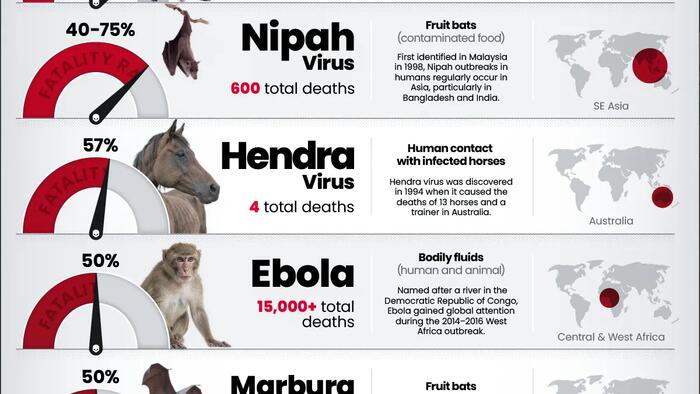
Some viruses infect millions but kill relatively few. Others spread less widely yet prove far more lethal once contracted.
This graphic,via Visual Capitalist's Bruno Venditti,ranks 10 of the world’s deadliest viruses by case fatality rate: the percentage of infected people who die from the disease.
Rabies tops the list, with a fatality rate approaching 100% once symptoms appear.
The data for this visualization comes from various sources such as theWorld Health Organization (WHO), theBC Centre for Disease Control, theAustralian Government, theEuropean Centre for Disease Prevention and Control,Reuters, and theUK Government.
The virus kills an estimated 59,000 people per year, primarily in Africa and Southeast Asia. The virus spreads primarily through the saliva of infected animals, especially dogs.
Despite being vaccine-preventable, rabies still causes thousands of deaths, mainly in Africa and Southeast Asia. Limited access to post-exposure treatment is a key reason for its continued toll.
Several of the viruses on the list cause viral hemorrhagic fevers, including Ebola, Marburg, and Crimean-Congo hemorrhagic fever (CCHF). These diseases often lead to severe internal bleeding and organ failure.
Ebola and Marburg both have fatality rates around 50%, with outbreaks concentrated in Central and Sub-Saharan Africa. The 2014–2016 West AfricaEbola outbreakalone killed over 11,000 people and brought global attention to epidemic preparedness.
CCHF, transmitted primarily through ticks and livestock, is more geographically widespread across Eurasia and Africa. While its fatality rate ranges from 10–40%, it causes an estimated 1,000–2,000 deaths annually.
Most of the viruses ranked here originate in animals. Fruit bats are linked to Nipah and Marburg viruses, while rodents are associated with Lujo virus. Camels are the primary reservoir for MERS-CoV, first identified in Saudi Arabia in 2012.
Source: ZeroHedge News
