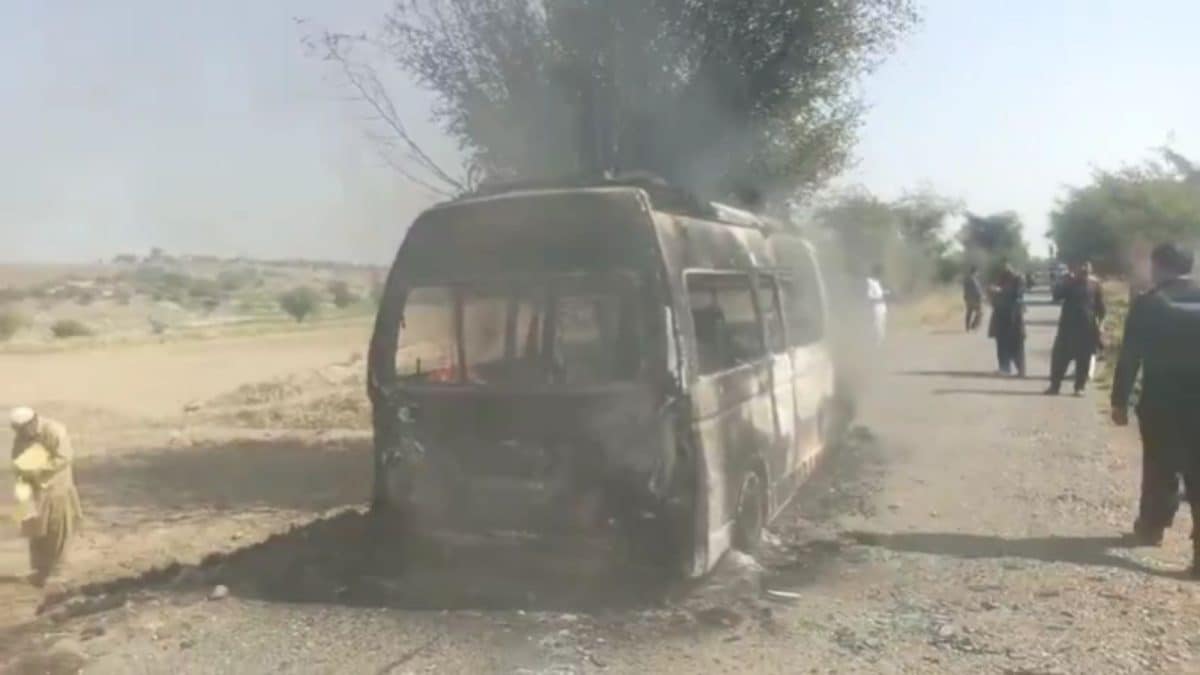
A paramilitary post in a district of Pakistan’s restive Khyber Pakhtunkhwa province, came under attack on Monday when a drone loaded with explosives wounded several officers.
According to police and local officials, the attackers later ambushed two ambulances being used to transport the wounded, killing three officers and wounding two rescuers.
District police spokesman Shaukat Khan said the incident took place in the Karak district of Khyber Pakhtunkhwa. While no group immediately claimed responsibility for the attacks, suspicion is likely to fall on the Tehrik-e-Taliban Pakistan (TTP).
But what is to be noted is that the security landscape in this province bordering Afghanistan has entered a volatile new phase as the TTP seems to have transitioned toward a sophisticated mode of hybrid drone warfare. The lethal quadcopter assault on the paramilitary fort in Karak is an example of the group’s ability to conduct remote precision attacks.
Top intelligence sources toldNews18that the strike took place in the Dargah Shaheedan area of Bahadar Khel, where a quadcopter loaded with explosives targeted a federal constabulary post. Pakistani authorities have accused the TTP, which Shaukat Khan said, has increasingly used drones to target security posts in recent months raising “concerns about the growing sophistication of such attacks".
The intelligence sources said the deployment of quadcopters is not merely a tactical innovation but serves broader strategic and operational objectives. By pairing offensive quadcopters with anti-drone countermeasures, the TTP is moving away from traditional attrition warfare toward a model of standoff engagement. This allows militants to strike from a distance without exposing their cadres to direct firefights, thereby preserving trained fighters while maintaining operational momentum.
The sources said a critical to this transition is the reliance on commercial off-the-shelf (COTS) technology. These quadcopters are inexpensive compared to conventional military hardware, yet they allow a small militant cell to achieve a disproportionate battlefield impact.
They said by using overhead attack angles, these improvised drones can effectively bypass the perimeter defences of fixed, predictable deployments such as forward operating bases and paramilitary forts. The use of UAVs has created a state of constant uncertainty for security personnel stationed in Khyber Pakhtunkhwa.
“Drones allow standoff attacks without exposing cadres to direct firefights," the sources said, adding that this tech-heavy approach effectively multiplies militant capabilities without the need for large-scale manpower.
The ability of the TTP to integrate aerial assaults with ground ambushes suggests a high level of coordination that threatens to strain security resources along the northwestern frontier, the sources added.
Source: World News in news18.com, World Latest News, World News
