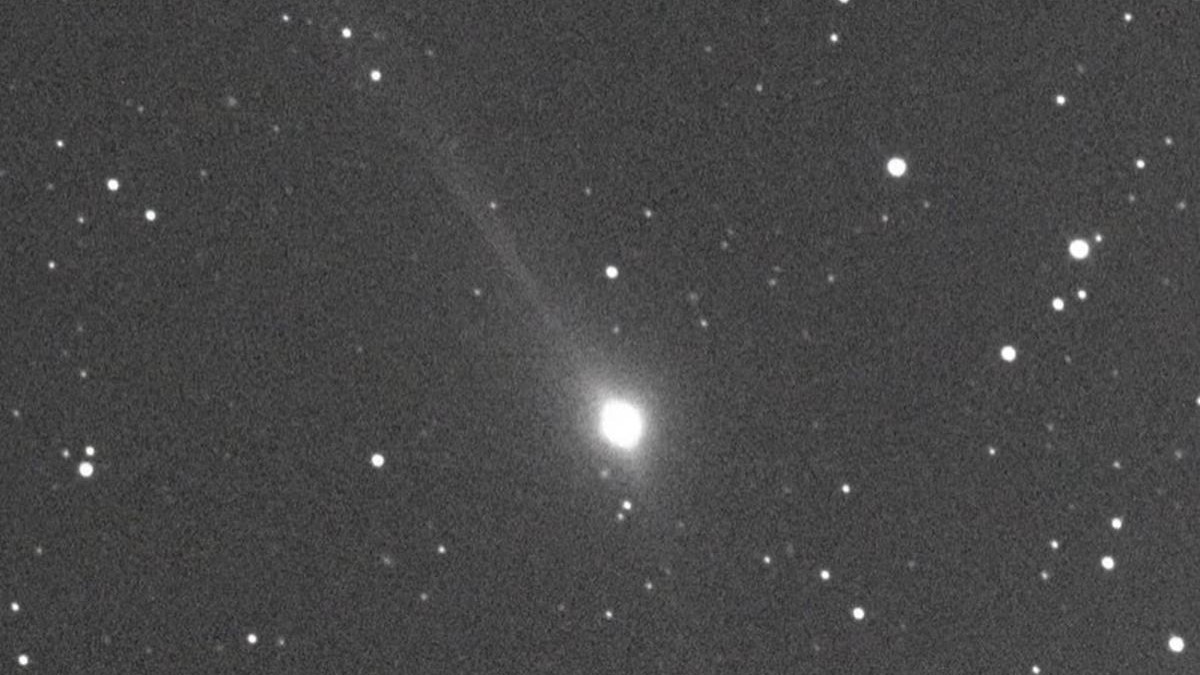
Scientists have proposed a daring mission to intercept interstellar comet 3I/ATLAS, the third such object ever detected in our solar system.
But there's one problem: the interstellar comet is moving away at immense speed. Any direct attempt to reach it would require technological capabilities beyond current limits.
Researchers suggest launching a spacecraft in 2035, using a carefully timed Solar Oberth manoeuvre—a technique that exploits the sun's gravity to accelerate a craft—to reach the comet. While the mission could take up to 50 years, it promises the first close-up study of material from another star system
This could offer insights into planetary formation far beyond our own.
Interstellar objects travel at velocities that make conventional missions nearly impossible.
Comet 3I/ATLASis already receding from the sun at more than 60 kilometres per second. Meaning, a spacecraft cannot simply chase it using standard propulsion. A direct approach was ruled out because the comet was detected only after it had passed Jupiter's orbit, missing the optimal launch window.
Adam Hibberd, a software and research engineer with the Initiative for Interstellar Studies (i4is), explained that the comet's speed and late detection forced the team to consider alternative strategies.
Live Sciencereported that the proposed Solar Oberth manoeuvre involves sending a spacecraft close to the sun, where its gravitational pull maximises the probe's speed during an engine burn.
This slingshot effect would propel the craft fast enough to intercept 3I/ATLAS, despite its high velocity and the distance involved.
According to the i4is team, a launch in 2035 would align Earth, Jupiter, and the sun with 3I/ATLAS, optimising the energy required for the manoeuvre. Hibberd explained that this timing is crucial: it reduces the demands on the launch vehicle, limits the spacecraft's fuel requirements, and shortens the mission's flight time.
Source: International Business Times UK
