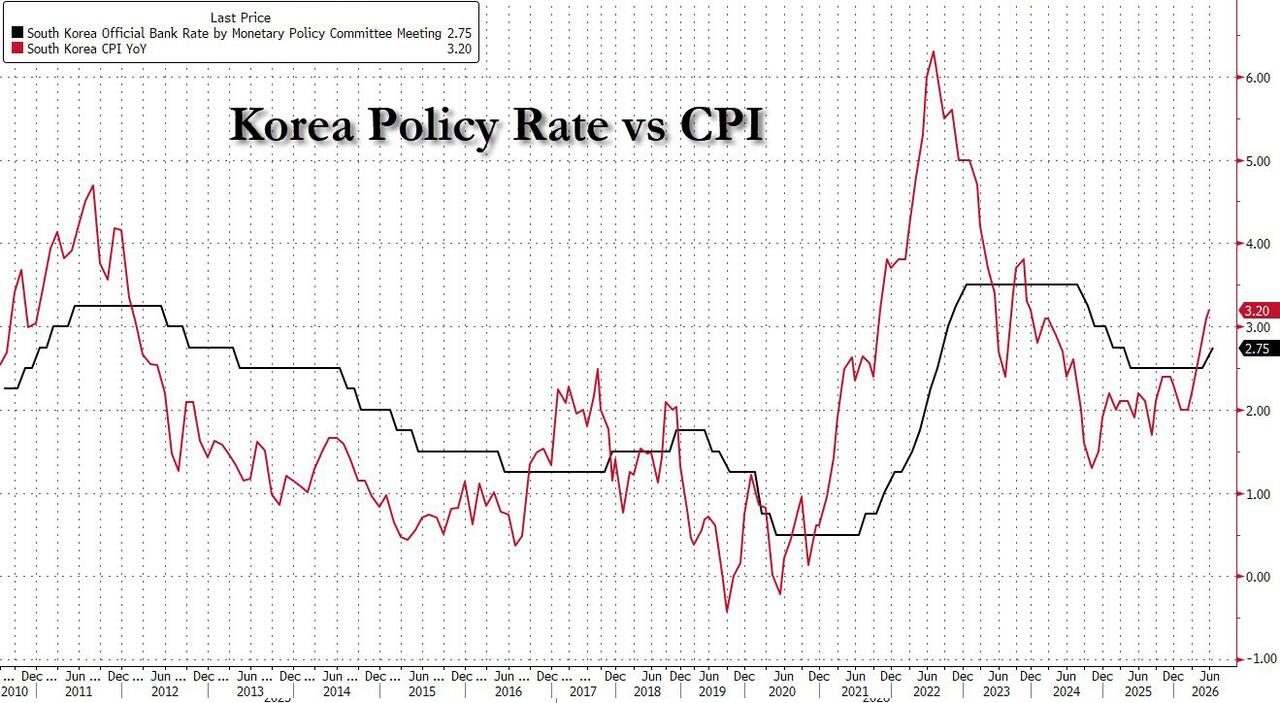
For the first time in over three years, South Korea’s central bank raised its policy interest rate by 0.25% points to 2.75%, inline with expectations, and kicking off a monetary tightening cycle aimed at containing inflationary pressures spurred by the AI-driven semiconductor boom. It also helped spark a fresh rout in Korean stocks whose daily volatility has become borderline farcical with daily 5% swings having become the norm.
The move on Thursday was the Bank of Korea’s first rate increase in more than three years as well as its first under Shin Hyun-song, a renowned international economist who took over leadership of the central bank in April. Before Thursday’s move, the BoK had held rates at 2.5% since May 2025 at the conclusion of an easing cycle.
As the FT notes, Shin has stressed the need for tighter monetary policy in recent weeks, pointing to robust economic growth driven by a surge in demand for memory chips on the one hand and persistent weakness in the won, elevated inflation and growing financial imbalances on the other (these, are of course, connected, as the collapsing currency helps cheap chip exports, which raises core inflation for consumer electronics both domestically and globally).
“Korea is expected to see the effects of the semiconductor boom spill over into domestic demand. Therefore, underlying inflationary pressures are likely to be stronger and persist for longer than previously anticipated,” he told a press conference on Thursday. “We will respond until we are convinced that inflation stabilizes at our target lev